
Stories
On a Sunday morning a few years ago, a transaction worth more than US$2 billion moved across a digital network.
It took seconds.
The fee was US$12.
In the traditional financial system, such a transfer would require multiple banks, settlement systems and intermediaries. It might take days to complete and could cost significantly more.
For Lory Kehoe, EU director at Aave Labs and founder of Blockchain Ireland, that moment illustrates the scale of the transformation now underway in financial markets.
The transaction took place on blockchain infrastructure — the technology underpinning tokenisation, a fast-emerging concept that could fundamentally change how assets are owned, traded and managed.
“How is that possible? Tokenisation, blockchain technology, stablecoins,” said Lory Kehoe on the latest edition of The Tech Agenda podcast.
For Nicola Sheridan, fintech and payments leader at PwC Ireland, the growing interest reflects the potential to rethink how financial systems operate.
Speaking on the podcast, Sheridan explained that, from investment funds and shares to real estate, infrastructure and even artwork, tokenisation converts ownership rights into digital tokens that can move across networks almost instantly.
“It is the concept of things being faster, things being cheaper, more efficient and easier to move around,” she says.
“If we think about the financial services sector, a lot of time and energy and effort goes into moving money around the world, essentially, and moving assets around the world.”
Research from PwC suggests that tokenised assets under management could grow from around US$90 billion today to more than US$700 billion by the end of the decade.
“If we tokenise an asset or we tokenise financial resources, it is easier and quicker to move that across borders, across currencies, with no paper involved, etc,” Sheridan says.
“There is the ability to have a 24/7 market and do things at any point of any day or night.”
Turning ownership into digital form
At its most basic level, tokenisation is about representing ownership digitally.
“Tokenisation is the digital representation of absolutely anything,” says Kehoe.
“At its core, tokenisation is the digital representation of a real-world asset. That asset could be a barrel of oil, a share certificate, a fund, or a property. Historically, these were recorded on paper or in traditional financial systems; tokenisation simply turns them into digital tokens on a blockchain.”
The concept reflects a broader trend in financial markets — the gradual shift from physical assets and paper records to digital systems.
“So ultimately tokenisation is that digital representation of things that used to be physical, and the whole area is kind of akin to, I guess, what CDs were to where we are today with Spotify,” Kehoe says.
Behind the concept sits blockchain — a distributed ledger technology that records transactions across a shared database.
“A key piece of infrastructure underpinning tokenisation is blockchain technology,” explains Lory Kehoe.”
“Every transaction is recorded on a shared digital ledger that is transparent and extremely difficult to alter, creating a permanent record from the very first transaction to the latest one.”
For financial institutions, the accompanying transparency and traceability offer significant advantages.
“It also has full transparency, so it can be fully audited,” Sheridan says. “As a firm with a large audit practice, , we always like an audit trail, so that’s another element.”
Faster markets and programmable assets
Much of the excitement around tokenisation comes from the efficiencies it could unlock across financial markets.
“So, tokens are the digital representation of whatever the underlying asset is,” Sheridan says.
“You can create a programmability aspect of those.”
Programmability allows certain actions to be automated directly within the asset.
Sheridan gives the example of dividends.
“So, if I hold a share in a company, for instance, and I am entitled to a dividend from that share, there’s a lot of people who need to push paper around a lot to actually make that happen until it gets into my account, whereas if we programme that into a token, that can all can happen in a much more automated way.”
Settlement is another area where tokenisation could have a major impact.
“For example, a US financial institution, and it wants to transfer funds to, let’s say, its Japanese counterpart, it can often take, four, five, six working days to actually transfer that money, across,” Sheridan says.
“The ability to almost wrap the underlying currency in a token allows the token to be transferred instantaneously.”
The way Sheridan sees it, speed also reduces financial risk.
“You don’t have that kind of time lag between when you undertake a transaction and when you get paid for it, there’s that counterparty risk, which can be very significant for banks. That is lowered obviously by virtue of doing it more quickly,” the PwC expert said.
Many institutions are already experimenting with the technology internally, according to Sheridan.
“If I think about some of the banking clients that I work with, they are, you know, essentially kind of using tokenisation to be able to move money around their own global organisations much more quickly, much more efficiently,” Sheridan says.
Opening investment to more people
Sheridan argues that tokenisation could also reshape who gets access to investment opportunities.
One of its key features is fractional ownership.
“ If we take, for instance, a piece of art, you can break that down, and the ownership of that piece of art can be essentially fractionalised,” Sheridan explains.
“You essentially don’t need to own the whole thing if you can’t afford to buy.”
The concept can apply to many different asset classes.
“That can be applied to an office block, that can be applied to a share,” Sheridan says.
“So, you can essentially lower the barrier to entry for the consumer.”
Kehoe gives another example: “If there is an expensive asset, it can be held by an institution, due to their deep pockets, or by ultra-high-net-worth individuals. It could be, as you mentioned, a piece of art, it can be a building, it could be a whiskey distillery.”
Tokenisation allows those assets to be divided digitally.
“What tokenisation enables is that instead of a whiskey barrel being owned by one person or a family, it gets broken down, let’s say, into 100 parts, and those 100 parts are all basically able to be sold to 100 different people and then tracked,” he said.
Sheridan sees this as part of a broader democratisation of investment.
“It’s about kind of bringing the retail investor in, like bringing them along the journey of being able to hold types of assets that might generate a higher return, that they don’t have access to today, and really democratising access to those assets,” she says.
Corporate finance opportunities
The technology is also attracting attention from corporate treasury teams.
“We see a lot of corporate treasurers very focused on what they can use tokenisation for,” Sheridan says.
“They want to achieve those goals of being more efficient in how they manage the money of the overall group.”
For businesses exploring the technology, Sheridan says the first step is understanding where it can create value.
“It’s really looking at where in their organisation would this add value?”
“Is it in the context of how they manage their money? How do they generate more yield from their money? How do they move money around the world more quickly?”
Regulation and trust
As with any financial innovation, Sheridan argues that regulation will be central to tokenisation’s development.
“In Europe, we have a regulatory framework for digital assets called MiCAR,” Sheridan says.
“The Irish Regulator is also very engaged in the discussion on digital assets and has recently put out a paper on tokenisation.”
Strong regulatory frameworks will help build trust in the system, she says: “It’s all of our jobs to make sure that that is sustainable, that it is robust.”
Lory Kehoe sees regulation as a positive step.
“Regulation brings standards, and standards brings adoption, so it’s actually a positive thing at an institutional level, at a consumer and retail level as well.”
Ireland’s opportunity
If tokenisation becomes a major part of global financial infrastructure, Ireland could play an important role.
“We have such a big financial services sector, we have such a big tech sector,” Sheridan says.
“That’s over 150,000 people employed in those sectors.”
Those industries create the foundation for innovation.
“These are the rails on which the next generation of the financial services sector is going to be built,” she says.
Ireland has previously built successful financial ecosystems, and Sheridan believes the country can do it again.
“If we think about 25 years ago, there were no Exchange-Traded-Funds (ETFs) in Europe,” Sheridan says.
“Ireland is the second biggest domicile in the world now, and that’s because we had the right skillset and the right focus and energy to really build that infrastructure.”
She believes tokenisation could offer a similar opportunity, albeit one that has a much broader reach across the industry.
“I definitely see opportunities here for us to do the same,” Sheridan says.
The opportunity and the future
Financial institutions are already beginning to adapt.
“I would say we are seeing a number of the largest banks, asset managers, insurance companies in the world moving into this and actually implementing it in their businesses,” Sheridan says.
Part of the shift is being driven by generational change.
“A lot of asset managers are very focused on that great wealth transfer from a generational perspective.”
Younger investors expect digital access to assets.
“That new generation of investors are going to be digital first,” she says,
The infrastructure for that shift is already visible.
“There are over five billion wallets in the world,” Sheridan says.
“That’s only going to go in one direction.”
For Kehoe, the scale of the opportunity is clear.
“For me, it is a multi-trillion-dollar story,” he says.
Sheridan believes the shift represents a once-in-a-generation change.
“The opportunity is a once-in-a-generation one,” she says. “We are changing the rails on which the industry operates. It’s like moving from paper-based to electronic-based banking. It’s not an incremental change; it is a full rebuild.”
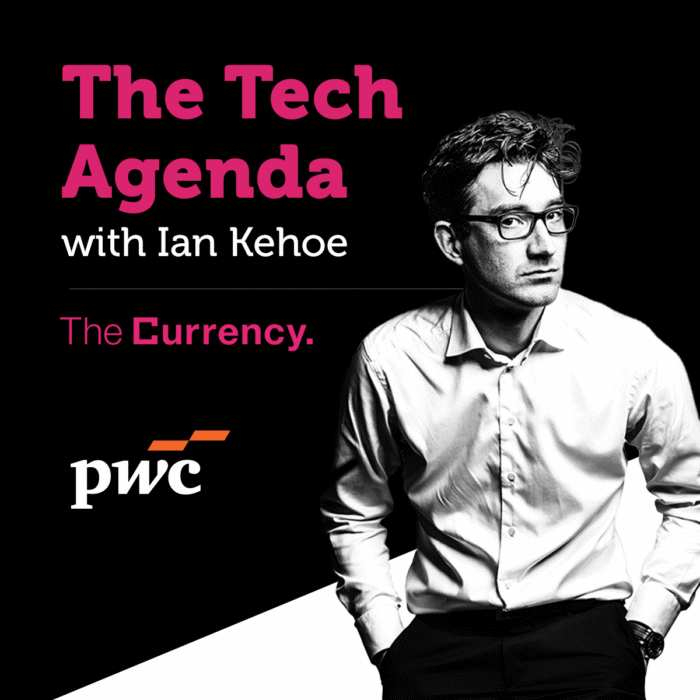
The Tech Agenda with Ian Kehoe podcast series is sponsored by PwC.