Stories

What a difference a year can make. Microsoft Ireland recently held its AI Summit event in Dublin, a gathering of partners and customers, and the change compared to last year’s event is stark.
The recurring theme last year was AI adoption. A year later, adoption isn’t the question anymore. Organisations big and small are using AI in its various forms and have moved beyond testing and learning. The question now is around outcomes.
Microsoft Ireland general manager Catherine Doyle said that Ireland has moved from lagging behind in Europe on AI to a leader, citing Microsoft’s Global AI Diffusion Report, which positions Ireland in fourth place globally for AI adoption on a per-capita basis.
“The story has moved on considerably. AI is now being applied across all processes end-to-end. In many cases, it can automate itself; it doesn’t need to be told what to do at every step. This is where the challenge really starts,” Doyle said.
“I know a lot of you are in that situation right now, where you’re trying to figure out how you actually make this work, where you truly automate your process across your entire business end-to-end and you really deliver that true value back to your organisation and set the platform for how you will scale AI into the future.”
The most recent advances in AI adoption and strategy have seen the emergence of frontier firms – companies that are embedding AI tools like Copilot into everyday operations and decision-making.
“Put simply, this means taking an inside-out approach to how you deploy AI in your organisation,” Doyle explained.
“Rather than finding a singular use case or a project, where can we unlock real value by moving beyond the prompt-based, declarative status of AI into true process automation? A frontier firm is run by people but powered by AI, using that intelligence on tap to get stuff done.”
It means employees have a much better experience. The busy work is done by AI, and the really smart work, which adds the most value, is done by humans.
These are all questions at the core of the research of anthropologist and futurist, Dr Lollie Mancey, who studies how humans interact with AI, how it will change the way we work and how we adapt to that.
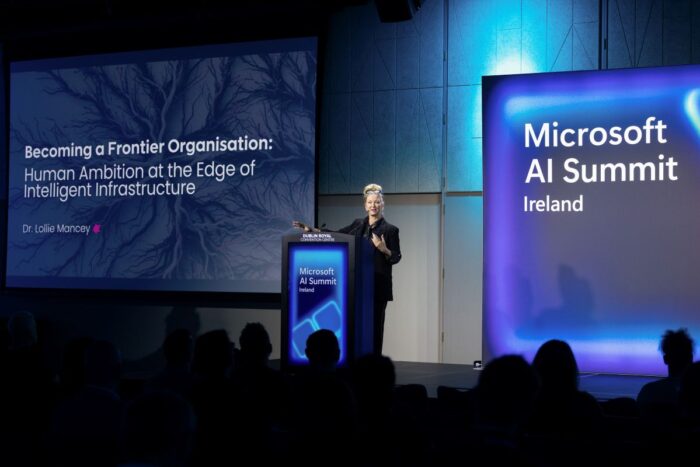
“How will we interrelate with all of this as humans? We don’t act in a rational way a lot of the time, so this is going to be a really interesting payoff in terms of our interactions, of how we move forward with it,” Mancey said in her keynote speech.
“It’s not going to affect just our workflow, it changes the idea of perceived competence. How are we going to adjust the salary model even when we’re paid for productivity over time? We still have that clock-in, clock-out hours thing. What is that going to look like? How are we going to adjust accordingly? We have never had a change like this.”
The built-in mindset
This change in mindset was on display with Microsoft’s partners, and EY is helping these organisations engage with and embed AI through tools like Copilot.
“The key thing I’d love people to think about is that you move your mindset to built-in AI, you start to think about a very different value creation journey,” said Eoin O’Reilly, head of AI and data at EY Ireland.
To date, many organisations have been thinking about AI as a bolt-on rather than built-in – and there’s a critical difference between the two. The bolt-on approach often just means using a tool side by side with existing processes, rather than the built-in mindset, where AI is integrated deeply.
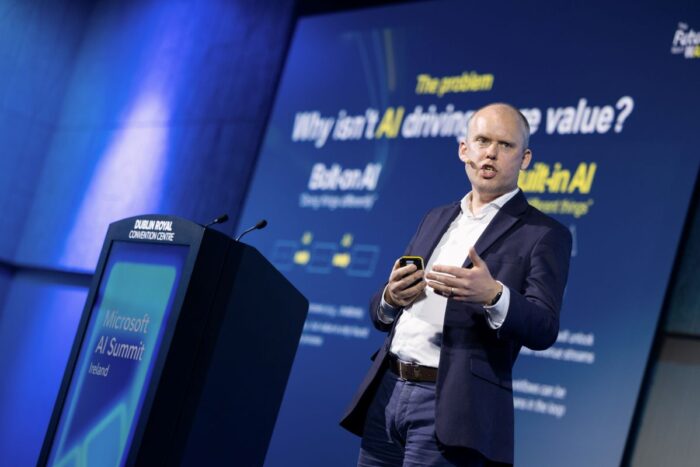
“With bolt-on, we’ll only get so far in value creation and it’ll start to reach a limit. In EY, what we’re talking about more and more with our clients is how to reimagine AI at the core,” O’Reilly said.
The bolt-on approach can yield promising results initially but can quickly fall prey to the law of diminishing returns.
“Every use case you add, you’re recreating, you’re starting from scratch, you’re not thinking new. You’re constantly creating the independent piece of AI that sits in one process, then in another process, then in another process. With built-in AI, you start to bend the curve in an upward value creation trajectory.”
But what that built-in experience will look like for each company will differ and that can be seen in the diversity of partners.
Mark Dineen heads up technology at EirGrid, which manages and operates Ireland’s electricity grid and has been overseeing AI deployments in achieving greater efficiency at the organisation.
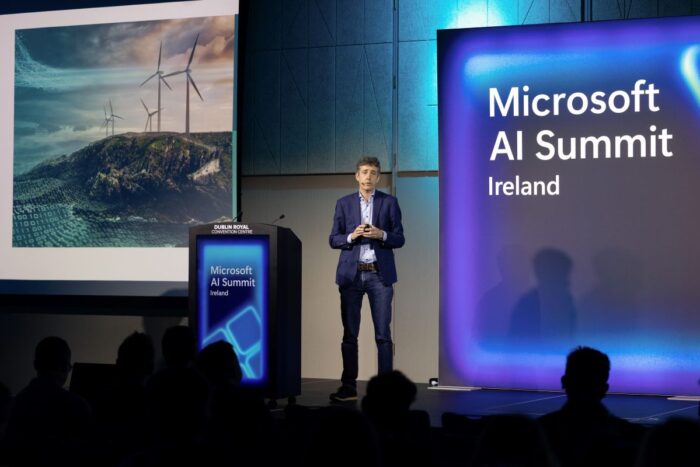
“As a regulated utility, there’s a lot of process and documentation that goes into our day-to-day work, so definitely one of the key use cases for us in using AI to help drive efficiency within that space.”
EirGrid serves a critical function in keeping the country’s grid operating and, with that in mind, the organisation has to move with caution in deploying AI when compared with other organisations.
“In terms of critical national infrastructure, there are no plans to let AI agents loose in our control room where operators balance supply and demand to keep the lights on. We do plan and we are looking at things like decision-support tooling.”
EirGrid is a prime example of the types of critical infrastructure bodies that fall under the strictest provisions of the EU AI Act, with the need to have a bird’s eye view over how the technology is being used.
That’s in contrast to Diageo, another Microsoft customer, which has different goals and metrics to follow. Tiernan O Morain, digital transformation director at the drinks maker, said: “For me, what’s exciting about AI is its ability to bring together information and context across systems in a more natural way. In large organisations, that creates real opportunity by helping people get to the right insight faster, make better decisions and focus their time where they add the most value.”
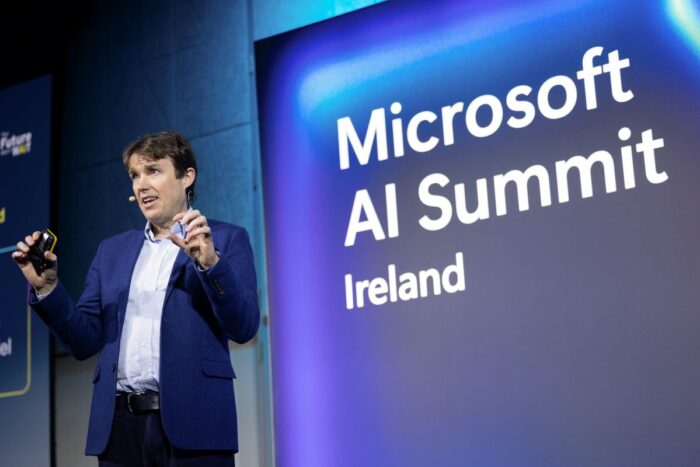
“We’re going to see digital assistants embedded in the daily workflow. Insights won’t be searched, they’ll be delivered,” he explained.
“I met a colleague in the finance team recently. She had a 59,000-line Excel sheet. She had pivot tables up on top. She’s spending a day and a half every month going through that to surface insights. She’s a super bright person, and that’s no way to start your career. How can we use tools and technology to better service that insight much quicker?” he added.
“Far too much time is spent by colleagues on low- or no-value tasks, so the future is really around moving from navigating the systems to AI navigating the systems for us.”
Meanwhile, daa International, a subsidiary of daa PLC, the operator of several international airports, has turned to Copilot to aid in imagining and designing new airports for its clients across the globe. This includes everything from building tender documents to designing immersive designs of what an airport will look like.
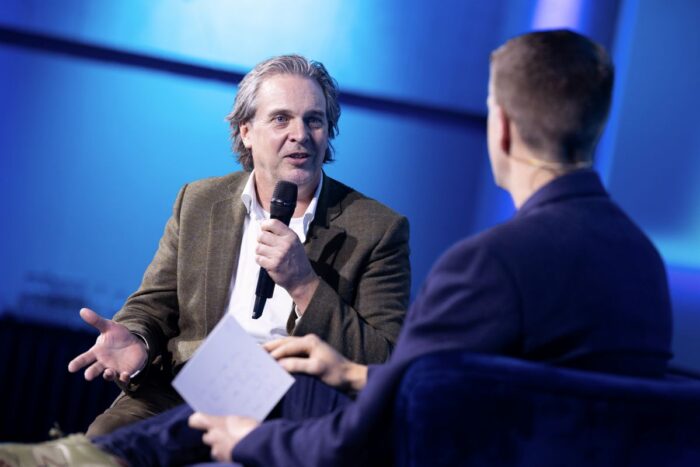
“We leveraged Copilot AI to accelerate our analytical workflow – from market research and demand modelling to calculating arriving and departing passenger volumes and baggage loads. It enabled us to rapidly test processing assumptions across every passenger and baggage touchpoint, and from that build a robust, data-driven Basis of Design for the architects and wider delivery team to develop the airport concept with confidence,” explained Stephen Byrne, head of advisory, daa.
Task migration
Alexia Cambon is director of research at Microsoft and is tasked with understanding how AI is transforming the workplace for its partners and at organisations like daa.
A critical example of this, aided by AI, is what Cambon calls “task migration”.
“Imagine, for example, an engineer who has built a product. Typically, what happens is the engineer would take that product and pass it off to marketing for marketing to then do its magic and create the first marketing plan,” Cambon said.
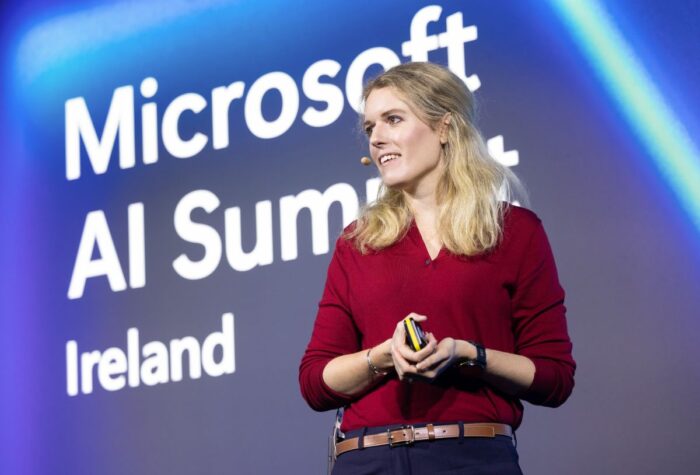
“In this new world where I can build a marketing agent that provides me what we call the MVE, the minimum viable expertise, to build that marketing plan, it is conceivable that that engineer could all of a sudden create the first draft of the marketing plan.”
The engineer knows the product but they don’t have the marketing expertise. AI agents are driving task migration, Cambon said, where one task moves across the boundary from one function to another.
“That doesn’t mean marketing goes away, it just means one task within marketing has left marketing and moved over to engineering because we’ve provided the engineer with the minimum viable marketing expertise to do that first draft.”
This task migration is one example of a broader shift towards what Cambon describes as “digital labour” – a new category of work that sits outside traditional models of human and machine labour, requiring organisations to rethink how work is structured and managed.
“We can call it digital labour, we can call it agentic capital, we can call it AI, whatever you want to call it. It actually sits outside of that old framework that we’ve never really thought about updating,” she said.
“That means we have to rethink how the company runs because you might have noticed your entire company was structured on that old economic reality. We have an IT department that manages machine labour. We have a HR department that manages human labour. Who manages digital labour? Do we need a new department? Do we need to merge departments?”
This mirrors remarks by Catherine Doyle, who said the traditional frameworks for running a business – including how work and skills are organised – are no longer applicable.
“The success of it depends on the interconnectivity of business processes across the whole organisation because the point of this is to unlock the intelligence that lives within your companies,” she said.
“To do that, we need to figure out how sales, how engineering, how marketing interconnect, how they work together and use AI across the entire process flow so value can be derived from the whole organisation, not just one single part. We also must rethink skilling. AI is for everybody, it’s not for a few select people or someone who showed they’re interested or somebody who’s done the training course. It needs to be put into everyone’s hands to create this frontier experience.”
Hands-on boardrooms
The pace isn’t going to slow down, said Microsoft UK and Ireland CEO Darren Hardman, and that means the top table at businesses needs to take a hands-on approach to AI if they want to be truly frontier firms.
Hardman has been in the technology industry for 30 years and this shift, he said, is further reflected in the more hands-on approach taken by boards and the C-suite than in the past.
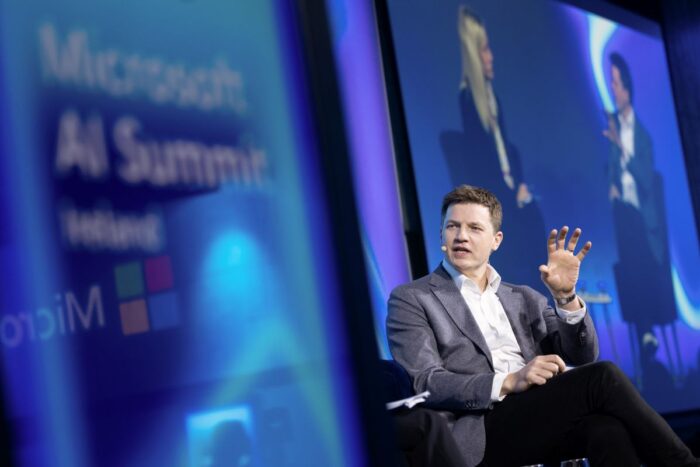
“With this era of AI, I’ve spent more time in the last two years in the boardrooms and the executive committees of our largest customers than I have in the previous 28.”
Unlike previous tech transformations, such as the move to cloud, it cannot be led solely by the CIO or CTO of an organisation.
“It’s not applicable for a CEO to just assign the task of AI to a CIO and so they have to be in the middle of it,” he added.
“They have to look into the eyes of the functional lead, the CHRO, the CFO, the factory-floor lead, the supply-chain lead and say, how are you with your knowledge of the business processes that you run – how are you transforming for AI for the future?”
This is partner content and has been produced in association with Microsoft.