Voices

When Gráinne Seoige told the Oireachtas media committee in recent days that “the crime is in a Formula One car and we are chasing after it on a tricycle”, she was not reaching for a neat metaphor.
She was describing, based on her own story, the experience of navigating an Irish system that places process above protection.
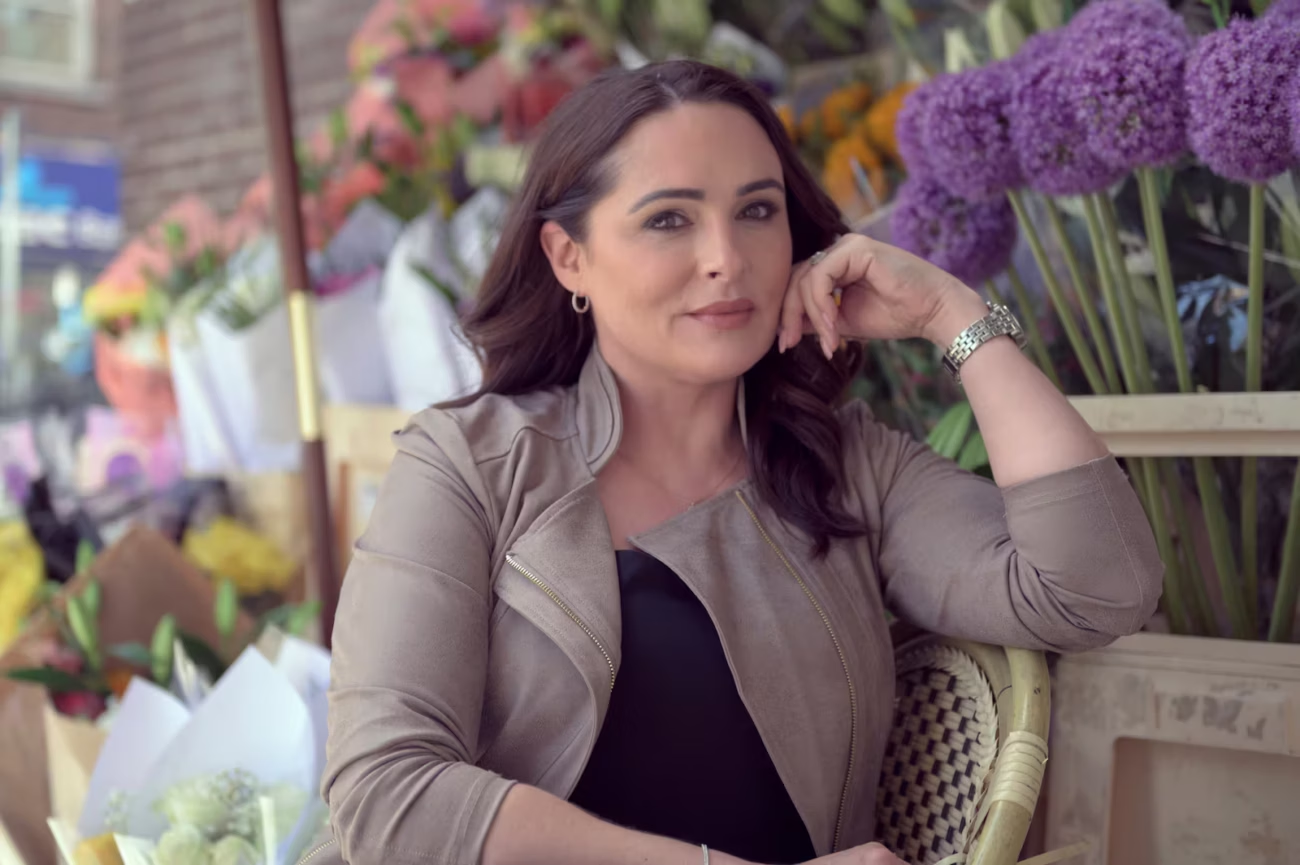
A television presenter, Seoige ran for Fianna Fáil in the general election last year. She did not get elected, but what’s important here is what happened during the campaign, and the failure of the State to protect her.
As polling day neared, a fake sexual image of her — generated using artificial intelligence — was circulated on WhatsApp groups. The image was non-consensual, sexually explicit and entirely fabricated. Yet, it spread quickly.
Seoige did what victims are advised to do. She reported the image to the platform. She went to An Garda Síochána. She followed every procedure recommended to her.
And then she hit a wall.
Gardaí were unable to compel the person in possession of the image to reveal where it came from or who else it had been sent to. The only option presented was to seek court orders for every phone suspected of containing the image. This was clearly impractical and unrealistic.
As Seoige later put it, privacy for the abuser was allowed to trump protection for the victim.
In the end, she found herself tracing the image manually.
“I had to find someone who had the image and ask them where they got it,” she told the committee. “And then go to that person and ask them.”
This is the reality Seoige brought before TDs and Senators — not as a would-be politician or former broadcaster, but, in her own words, “as a victim who is angry about what happened to me, and about the impact it had on those closest to me”.
She described the constant retraumatisation that followed.
“Every man you meet you wonder, have you seen this image of me?” she said. “I shopped for months after this with a surgical mask. You’re so afraid to be seen in public you make yourself small and unseen.”
Since going public on the issue, Seoige has received hundreds of messages from women, parents and teenage girls who have experienced the same abuse. Many told her they had followed every official route — reporting to platforms, contacting gardaí — only to reach the same dead ends.
One case involved a 14-year-old girl who attempted suicide twice after an image shared privately was redistributed.
According to Seoige, the past few weeks have shown the worst of what AI can do, particularly with the launch of the Grok app on X, which enabled users to create and share sexualised images of women and children.
However, she said sharing platforms such as WhatsApp and Meta, also needed to be tackled.
“If Grok are the nuclear warhead, then WhatsApp is the Enola Gay that transports and drops the bomb,” she said.
Seoige was thoughtful, considered, and spoke with genuine passion.
Against this testimony, listen to the language coming from Government.
Minister for Media Patrick O’Donovan has argued that responsibility for the creation of non-consensual sexual images lies with users, not platforms such as X or tools like Grok, and that technology is moving too fast for the law to keep pace.
“Ultimately, at the end of the day, it’s a choice of a person to make these images,” the minister said in comments that were quickly criticised by the Dublin Rape Crisis Centre.
The minister’s comments reflect a wider pattern in how the Government has dealt with big tech. Rather than treating these companies as publishers, the State has repeatedly allowed them to operate as platforms. And instead of confronting their role in spreading false information — and now sexualised images — the focus has often been shifted elsewhere, as highlighted by O’Donovan’s remarks.
Grainne Seoige’s evidence exposes the emptiness of that defence. Again and again, she described institutional paralysis.
As she told the committee, “the law as it stands places the burden on the victim to identify every individual in the chain of dissemination”.
Minister of State for Artificial Intelligence Niamh Smyth has struck a more conciliatory tone. She has spoken of her “serious dismay” in meetings with X executives, welcomed the company’s“corrective actions”, and said she will continue to monitor the situation closely. “Concerns remain,” she says.
But concern is not the same as action. Voluntary safeguards are not enforceable protections. Geo-blocking is not accountability. And monitoring a platform is cold comfort to victims whose images continue to circulate while assessments are underway.
X is subject to a slate of relatively recent new digital rules at both a national and EU level. Coimisiún na Meán and the European Commission are tasked with implementing the likes of the Digital Services Act and the AI Act — rulebooks designed to, at least in part, prevent this type of tech-enabled abuse.
Smyth’s talk of “concerns” remaining highlights the lack of cooperation by the Elon Musk-led company and perhaps a sense of feeling untouchable. As we saw with the EU’s fine last month against X over a previous infraction, the response was belligerence from Musk with calls for US action against the EU. There was little in the way of accepting accountability for breaking the rules. That sort of response requires an even harder stance from lawmakers, and crucially, action.
Perhaps the most chilling moment in Seoige’s testimony came when she was asked whether she would encourage another woman to run for public office. “If any woman came to me and said ‘Should I go forward?’,” she said, “I would say, ‘If I were you, no. Don’t do it. What you will be put through is not worth it.’”
Ireland has faced abuse scandals before, where early warnings were ignored. Seoige explicitly invoked that history.
“This will be the abuse scandal of the 21st century if we do not act now: legislate urgently, be prepared to legislate again as this technology evolves, and ensure that all relevant regulators are empowered and ready to act,” she added.
Elsewhere last week…
As members will know by now, we announced a new partnership between The Currency and The Wall Street Journal — at no extra cost. We’ve already published some outstanding WSJ journalism and we’ve had a great reaction to it. Thanks to Oroko for being our initial sponsor of the new content.
Elsewhere, in a two-part series, Thomas revealed how a French property investor quietly amassed an €800 million Irish portfolio. Corum Asset Management was among the first international firms to acquire commercial property in Ireland after the financial crisis. As Thomas explained, its executives still see “patches of value” in office and retail deals here.
In his column, Ronan looked at the brittle nature of the Irish property market. Unlike the Celtic Tiger boom, he says today’s price rises are matched by rising rents. “That tells a different story – one of chronic shortage, institutional rigidity and mounting social costs,” he wrote.
In a year when caution dominated boardrooms, international acquirers increased their presence in Ireland last year. I examined new data from Renatus, which revealed what sectors are continuing to draw foreign capital — and how the market is changing as a result.
Fintech veterans Graham Byrne and David Crimmins have secured €5 million in backing from Santiago Capital and are closing a €500,000 seed round. Having started in Ireland, they plan to go to Europe. They spoke with Tom.