Voices
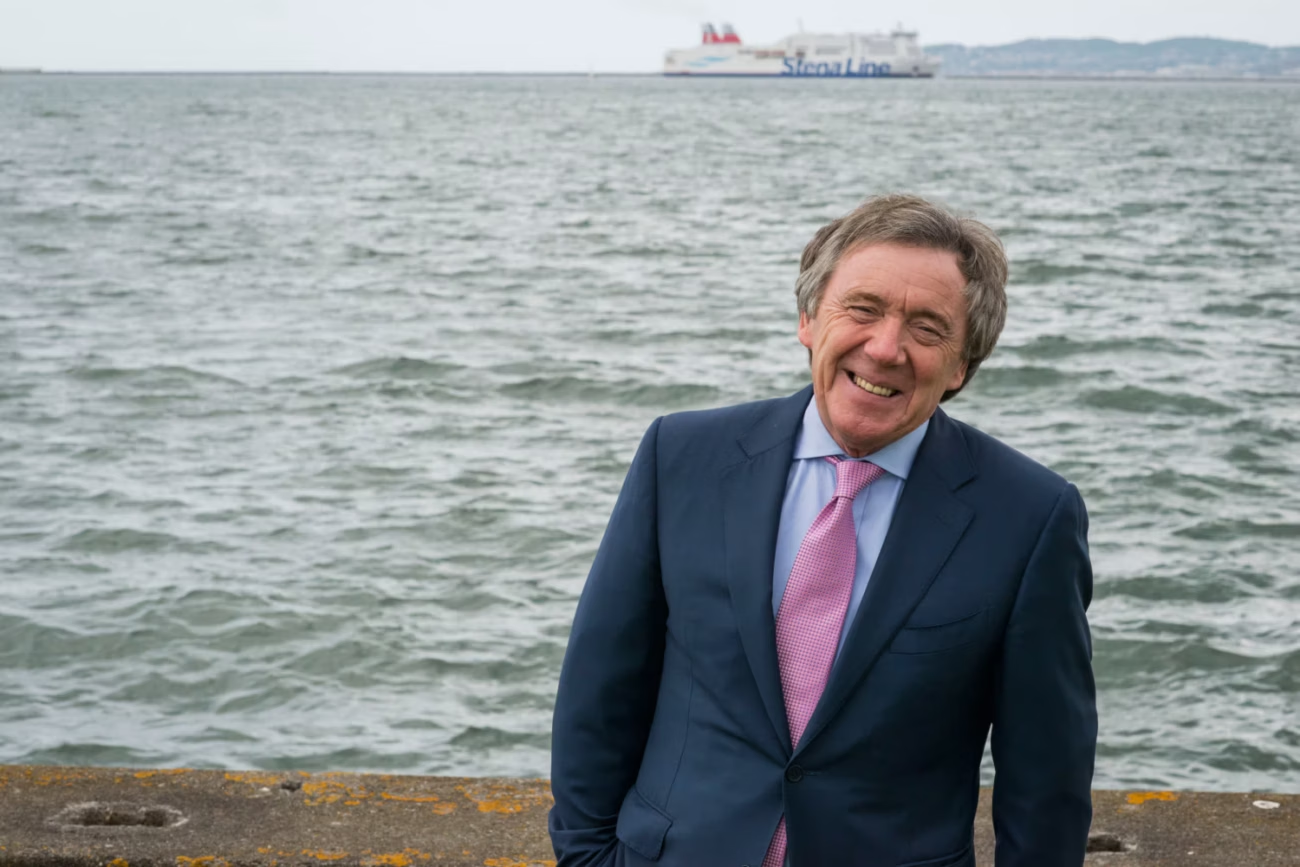
In March 2021, at the height of the pandemic, Tom sat down with aviation entrepreneur and investor Declan Ryan. Covid had grounded fleets worldwide, and the sector was reeling. Ryan’s view was blunt: Aviation had never effectively made its case, and as a result, the Government failed to recognise the scale of its contribution to Ireland’s economy.
As a counterpoint, he pointed to the Irish Farmers’ Association (IFA). “I always make the joke that the aviation industry needs to appoint whoever was the previous head of the IFA. If this was affecting agriculture, there would be war,” Ryan told Tom.
It is hard to disagree. The farmers’ lobby has, over many decades, been unswervingly successful. You can see it in budgets. You can see it in legislation. You can see it in the tone and the rhetoric that emanates from ministers and policymakers. The strength of the lobby is one of the main reasons the Government utilised a vast amount of political capital by voting against the Mercosur trade deal. It is also one of the reasons why the State helped secure an extension of the nitrates derogation.
The IFA is immensely powerful and incredibly influential. It has also, for many years, shown itself to be politically savvy.
And this is what makes its position on Larry Murrin, the chair of Bord Bia, so baffling and bemusing.
For the uninitiated, Murrin is the chief executive of Dawn Farms Foods, a central plank of the Queally Group and one of the country’s biggest food businesses. He is also a restaurateur, owning a string of cafes and a stake in some of Dublin’s best-performing restaurants. He is exactly the sort of person you want to lead the agency charged with developing the Irish food industry. He doesn’t need the money nor the hassle of doing the job. But he does it anyway.
Yet, the IFA want him to be ousted. Why? Because his company imports a tiny amount of beef from Brazil, a country that is essentially the nemesis of the Irish beef industry.
It has gone far beyond rhetoric. It has become both deeply personal and profoundly physical.
In recent weeks, there has been a continual protest outside the headquarters of Bord Bia in Ballsbridge in Dublin. I walked by last week. A small scattering of protestors were there, doing their hours, waiting to be replaced by the next crew. They even have a portaloo – for a period, they occupied a portion of the building.
IFA president Francie Gorman has said the move underscores the deep frustration and anger over Bord Bia’s failure to act on the matter.
“It will take some time to rebuild confidence in Bord Bia among farmers. For every day that this goes on, it will take longer. Even at this stage, those who can retrieve the situation should step up and resolve the matter,” according to Gorman.
Murrin, to his credit, has not been for turning. He attended the Oireachtas Agriculture Committee hearing on Thursday afternoon, where he said he had little intention of resigning. He dismissed claims by committee members that Dawn Farm Foods’ limited use of Brazilian beef created a conflict of interest with his position as Bord Bia chairman or compromised Ireland’s food safety standards.
Dawn Farm Foods has previously stated that Irish beef represents the majority of its supply and, together with beef from the UK and other EU countries, comprises more than 99 per cent of total supply in 2025. Brazilian beef accounted for under 1 per cent.
“Sourcing a small quantity outside Ireland does not diminish our commitment to Irish beef or farmers. It is, for us, a necessity that underpins our business,” Murrin told the committee last week.
Murrin said his position on the board had been presented to him as an “ultimatum” by the farming organisations, adding: “I don’t do ultimatums – unless they come from my wife.”
His role has been raised at board level where he got the support of most, but not all, members.
In a statement issued after the most recent board meeting, Bord Bia chief executive Jim O’Toole said “all perspectives” were heard and “carefully weighed”. He said the board had “reached an outcome” to support Murrin as chairman, but added that the decision was “not unanimous”, acknowledging that the IFA and the Irish Creamery Milk Suppliers Association did not support him.
Michael Carey knows more than most about the nuances of running a business and chairing state bodies. He chaired Bord Bia for seven years and, before his resignation last year, chaired both Enterprise Ireland and the Housing Agency. He has done the State some service, albeit he has been low-profile in recent times due to his resignation from the latter roles over the failure of his company to file annual accounts on time – East Coast Bakehouse is currently in examinership.
However, on LinkedIn, Carey broke his silence to come out in favour of Murrin. “He is without question the best chairman Bord Bia has ever had, and has contributed more than probably any individual to the great success of the Irish food industry,” he wrote.
“His businesses have supported Irish suppliers and farmers for decades, sourcing ingredients and services locally. He has advised and mentored dozens of food entrepreneurs. He has provided a vast amount of advice and guidance to governments. All of this is based on his deep understanding and unparalleled experience of our sector. There is nobody better placed to lead the board of Bord Bia, to ensure the continued success of the Irish meat sector on its international markets, for the benefit of all its stakeholders, including farmers.”
The way Carey sees it, the meat industry is an international one. “It is a global sector that depends on international trade. To suggest that we should be isolated from the requirements of these international customers is absurd. The hugely successful Irish-based meat businesses are fully immersed in this international trade, and right so [sic],” he wrote.
Murrin is right to hold his ground. Securing top-tier expertise for state boardrooms is hard. It would be easy for Murrin to walk away and continue to excel in the private sector. But he has opted to give something back, despite the fact that there is little in it for him except controversy.
If the IFA can force the hand of the Government on this issue, it would set a damaging precedent.
In reality, Larry Murrin is collateral damage. This is a proxy war, not about a chairman or a fractional percentage of imported beef, but about power, control and the fury within the farming lobby over Mercosur and the direction of travel of Irish and EU agri-food policy.
Expert analysis, led in Ireland by former Trinity College professor of European agricultural policy Alan Matthews, has shown that the impact of the limited beef trade liberalisation with South America introduced by the Mercosur trade deal could only be marginal on the incomes of Irish farmers.
The IFA would garner much more public support by lobbying for stricter inspections of all non-EU meat imports, existing or future, after the Farmers Journal recently revealed that Brazilian beef treated with banned hormones had entered the food chain. More fundamentally, farmers are gearing up for difficult negotiations under the upcoming Irish presidency of the EU to set the European budget for the next seven years, including the level of farm supports.
Bord Bia has become the battleground because it is visible, symbolic and influential.
The irony is stark. An industry that has mastered the art of political leverage risks overplaying its hand by turning on one of the most credible, experienced and internationally respected figures it has.
In a global food system defined by trade, complexity and compromise, absolutism may win headlines, but it rarely wins outcomes.
Elsewhere last week…
Charlie O’Loughlin built a discount empire that thrived through the crash. Fifteen years later, his EuroGiant chain has collapsed under the weight of high rents, supply shocks and a rapidly changing retail landscape. Tom had the details.
He started out as an accidental accountant, yet ended up leading one of Ireland’s fastest-growing professional services firms, S&W. John O’Callaghan reflected on the long journey from Sydney to Dublin, and how his Ironman mindset drives him forward.
Paul Murphy has been protesting and advancing his core belief in socialism all his adult life. In a wide-ranging interview with Dion, he talked about injustice, not caring what people think of him, and Roy Keane.
US AI company Partsol Global has moved its headquarters to Dublin. CTO John Callahan explained to Michael how its defence-built AI is used to combat terrorism, how it’s entering the private sector, and why Ireland could become a major AI hub.