Voices
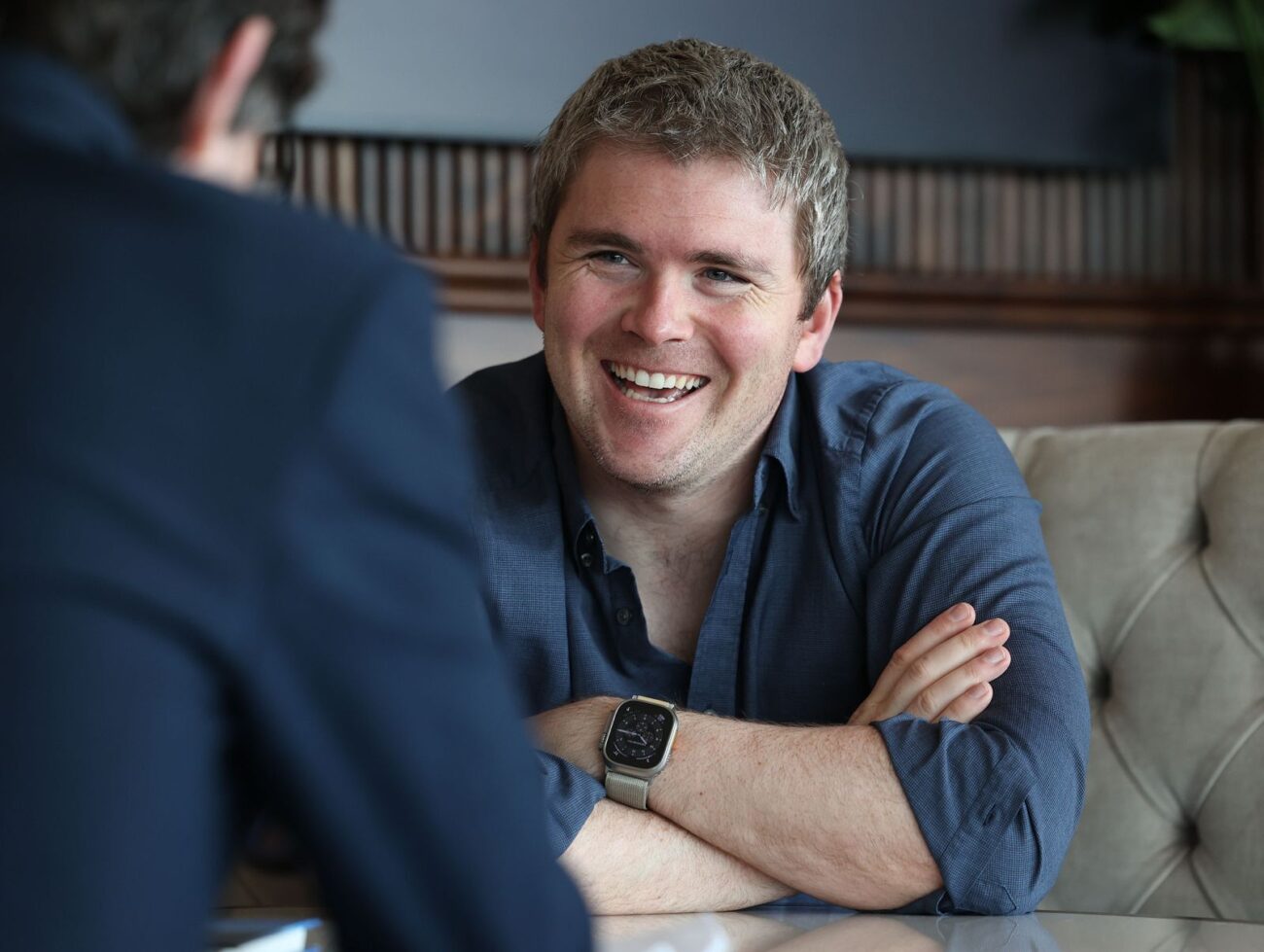
Last April, I spent a day with John Collison.
In the morning, he gave me a tour of Weston Airport, the private airport that he, along with a consortium of other investors, acquired in 2021 from the Galway builder Brian Conneely.
It was a passion project. Collison, the billionaire co-founder of payments giant Stripe, learned to fly at 17 and he’s been captivated by aviation ever since.
Over coffee, I asked him about his formal role with Weston and the time commitment.
After all, his day job is president of a payments juggernaut that is widely regarded as the world’s most valuable private company.
“Do I have a title?” he said. “Owner? Maybe I need to get some Weston business cards.”
Later that day, I did a public interview with him for an event organised by the Kildare Chamber of Commerce. The room was captivated by his story, his insights, and his honesty.
When we talk about the doyens of Irish business, we fall back on major figures such as Michael Smurfit, Tony Ryan, and Tony O’Reilly. Of the current crop, the conversation gravitates to people like Michael O’Leary or John Magnier (as an aside, I have long felt that Denis Brosnan is often overlooked).
Yet, what the Collison brothers have achieved with Stripe has almost put them in a different arena. The scale of what the two have achieved is staggering – and often difficult to put into context. The company has created the plumbing of global e-commerce, the financial backbone of the internet.
In an era when Ireland has produced global executives, investors and operators, the Collisons stand apart because they built the platform itself. Stripe is not an Irish outpost of a multinational; it is a foundational layer of the modern internet economy conceived and led by Irish founders.
Most billionaires tend to operate at arm’s length – insulated by lawyers, filtered through PR advisers, wary of unpredictability. That day at the K Club, Collison did the opposite. He did not ask to see the questions in advance. There were no preconditions. He took questions directly from the floor and answered them thoughtfully, sometimes at length.
The striking thing was not just the openness, but the framing. He spoke less like a tech titan and more like a custodian. His central argument was that he viewed himself as a steward – of Stripe, certainly, but also of Weston. Both, in different ways, are long-term infrastructure plays. Both require patient capital, constant reinvestment and a willingness to think in decades rather than news cycles.
It is an unfashionable word in modern capitalism, but it is one Collison appears comfortable inhabiting: steward.
At the public event, I put to John Collison the inevitable question: When will Stripe go public? It’s one of the most persistent questions surrounding the company, given its towering valuation and the intense appetite for its shares. His answer circled back, as it often does, to stewardship.
“Why would you want to float it? It’s like – ‘oh, so you can sell your shares, obviously’. But it’s like, no, we’re working on this for decades to come, it is our life’s work, and we really enjoy it,” he told me.
“I feel like there’s an assumed worldview behind the question of flipping something and moving on to the next thing, which is absolutely not how we view the world. So, we’re much more interested in building a long-term, core piece of infrastructure, fuelling the economy, and having that run as a profitable business. And so, I think that’s why we may be less interested in that than other companies have been.”
I followed up by asking about the nature of stewardship of a company, as opposed to the constant demands of shareholders to earn more value. His response was emphatic: “The way it works with Stripe is, we started off with a very narrow idea. We said… we’re going to make payments easy for little start-ups. We had no view of the international side of things, we had no view on certain large corporates like we do today, which is a very narrow view. And then, if you’re paying attention, the market teaches you things, and you listen to what customers are saying, and you listen to what works and what doesn’t, and you are constantly listening and paying attention.
“And now we’ve been very closely observing the space for 15 years. Now, we actually know a decent amount about it, and we have much more experience in it than other people. But I think the big thing is the huge returns to [spending] a long time on a problem.
“And that gets to my second thing, which I think is, time horizon is just an advantage all by itself. With Stripe, we’re thinking about where we want to be in 10 years’ time, where we want to be in 20 years’ time. I think a lot of our competitors, in ones where it is a public company, they’ve had a few CEOs over the past few years, and they’re constantly changing their strategy. That makes life harder for them.”
The float, when it comes, will be one of the most significant listings involving Irish founders in modern history. Yet in my conversations with John Collison, public markets have never seemed like the end goal. Going public is a financing event, not a finish line. The objective has always been durability.
That durability was tested during the tech downturn. As valuations contracted and growth-at-all-costs fell out of favour, Stripe recalibrated. Its valuation fluctuated, but, now, based on the strategy being advanced by the brothers, it has peaked again.
In recent days, Axios reported that Stripe is arranging a tender offer that would give the company a valuation of at least $140 billion.
That is a jump of more than $30 billion from its most recent valuation last year, when investors said Stripe was worth $107 billion. The latest deal is a sign that Stripe may continue to delay an IPO.
It is easy to forget that the Collisons began as teenage entrepreneurs in Limerick, building and selling software before most of their peers had chosen university courses. That early global orientation – building for the world, not just for Ireland – has defined Stripe’s trajectory.
Yet, John Collison has also been quick to dispel the myth that surrounds the company. In a previous interview, in 2024, Collison told me that the idea of two brothers developing a business in their bedrooms was fascinating to people, but that it skirted reality.
“People want to reduce it to a few personalities for understandable reasons,” he said. “John and Patrick did some coding. Poof. Here is the Stripe of today.”
Collison has always pointed to other factors.
“There has been no period in Stripe’s history when we have not been fixated with hiring really talented people and those people have made major contributions,” he told me, adding: “With a lot of companies, that talent story gets undersold.”
Interviewing Collison over the years, I have been struck by how rarely he speaks about “winning.” Instead, he talks about building – better tools, broader access, deeper integration into the fabric of online business. Success, in his telling, is a byproduct of usefulness.
That mindset may explain why Stripe has endured when so many fintech darlings have faltered. It has been less concerned with fashion than with fundamentals.
Ireland has produced its fair share of empire builders – big personalities, bold dealmakers, the kind of leaders who like to make a splash. The Collisons feel a bit different. They’re not trying to dominate the headlines. Instead, they’ve positioned themselves right at the centre of how modern commerce actually works, quietly building and maintaining the systems that everything else depends on.
*****
Elsewhere last week, Thomas explored the hospitality businesses run by publican Alan Clancy to understand how he could simultaneously open the swanky Díon restaurant in Dublin and put other companies through insolvency proceedings. The answer lies in the separate financial backing and pandemic baggage attached to different sections of Clancy’s network.
Francesca continued to cover the legal falling out between businessmen Gerard Lane and Denis Connolly over the Tinakilly House hotel in Co Wicklow. The High Court heard evidence from Lane’s witness Kieran Wallace of Interpath, testifying as an independent expert on the dispute, and from Connolly.
As St Patrick’s Day approaches, I interviewed Richard Tierney, who runs the event in Dublin after a long career in live entertainment and commercial partnerships. Tierney told me that he took on Ireland’s national festival with a clear brief: make it sustainable and prove it could stand on its own two feet – read or listen.
Finally, former Central Bank governor Patrick Honohan reflected on efforts to rein in inflation across the western world in recent years. While Ireland performed better than many peers, no country escaped unscathed – and there are lessons for both governments and central bankers to learn, he wrote.