Voices

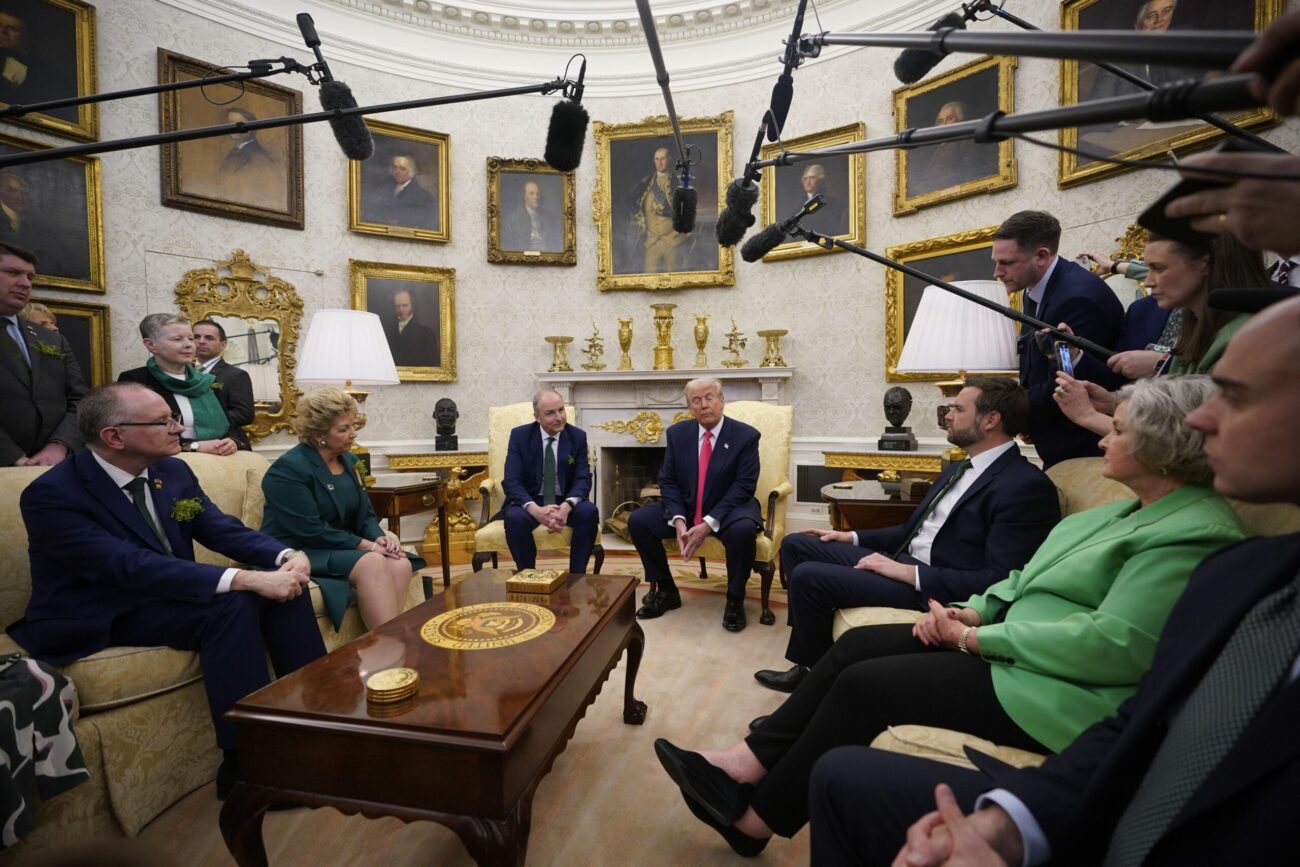
If you think Taoiseach Micheál Martin is facing an awkward time visiting the White House this St Patrick’s Day, spare a thought for the diplomats currently in the middle of a six-yearly exercise to define what exactly Ireland wants from its relationship with its superpower neighbour off the west coast.
“A new strategy for Ireland’s relations with the United States will be presented by Ireland’s Minister for Foreign Affairs, Helen McEntee, later this year,” Department of Foreign Affairs officials wrote in a briefing paper for Tánaiste and Minister for Finance Simon Harris two months ago.
In response to The Currency’s questions about the content and timeline of the process to draw up the new US strategy, a spokesperson for McEntee’s department said: “The Department of Foreign Affairs and Trade has undertaken outreach to other departments and stakeholders on the development of a new strategy for the United States. That process of development remains underway.”
In the meantime, some clues are apparent in the note Harris received to prepare for his tour of California-based multinationals in mid-January. I recently obtained a heavily redacted copy of the document through a freedom of information request.
Ireland’s previous strategy for the US and Canada, running from 2019 to 2025, was launched by then-Tánaiste Simon Coveney during Donald Trump’s first US presidency. Some changes can be expected from the title down: the very approach of North America as a single, friendly unit cannot stand in the middle of a second Trump term marked by his threats to annex Canada, among other allies.
Language likely to evolve from the 2019 strategy also includes Ireland’s ambition to “take the initiative to support deeper and wider transatlantic ties at EU level to address key global challenges; play a lead role within the EU in supporting constructive dialogue with the US and Canada on shared international challenges”.
From climate change to humanitarian causes and conflict resolution, there is hardly any international challenge left where a constructive dialogue with the US seems possible. As for the plan to “advocate on behalf of our undocumented”, it has turned into consular fire-fighting to rescue Irish citizens from ICE jails.
Ironically, the friendly tone of Friday’s Ireland-UK summit illustrates a necessary rapprochement to counter the uncertainty in transatlantic relations, where Ireland’s North American focus was seen as a necessity to offset the risks of Brexit in 2019.
Diplomats must now be gazing into crystal balls to chart a course for the next six years – including guessing whether Trump will accept the results of this year’s mid-term elections or the constitutional reality that he cannot run for a third presidential term.
Another key selling point for Ireland is the simplification of regulation at national and European levels.
One aspect of Ireland’s strategy in its relationship with the US that remains unshakeable, however, is its appeal to American multinationals. The 2019 strategy aimed for a total of bilateral trade and tourism flows and investment stocks “approaching $1 trillion by 2025”.
Mission accomplished: Figures now available from the CSO and the US Bureau of Economic Analysis, while not yet complete, already show this sum was exceeded last year. This is despite the stock of US investment in Ireland now being $10.5 billion lower than at the 2020 peak of asset transfers to this country following the abolition of the double-Irish tax scheme, according to figures compiled in the US-Ireland Business 2026 report published by the American Chamber of Commerce last week.
“Ireland continues to attract more than its fair share of global and US foreign direct investment, although in 2025, due to US firms repatriation of capital, US foreign direct investment flows to Ireland declined. That said, we believe this was a one-off event,” American economist Joseph Quinlan wrote in the report. As if on cue, Anthropic announced a 200-job expansion of its Dublin office on Friday.
The briefing note Harris read on his flight to San Francisco shows Ireland is doubling down on its effort to attract US companies. Of 25 pages containing “key messages on Ireland” to convey to Silicon Valley bosses, the largest section, covering seven pages, is dedicated to “tax issues”.
While the top of this section (presumably on core corporation tax aspects) is redacted, the document goes on to detail measures from the completed participation exemption and R&D tax credit enhancements to the reform of Ireland’s taxation regime for interest, due in the next budget and “focused on supporting business”.
Multinationals routinely use intercompany debt interest to repatriate profits in a tax-efficient way. “The Irish government is pursuing this initiative so that our corporation tax code continues to be at the forefront of competitiveness and remains attractive to investment while aligned with international best practice,” Department of Finance officials wrote.
Another key selling point for Ireland is the simplification of regulation at national and European levels as the Government prepares to take the EU presidency from July. “Ireland strongly supports the work underway at EU level to declutter and simplify EU tax legislation,” Harris was advised to tell Californian companies.
National efforts to modernise planning and improve energy infrastructure were pitched to data-centre users.
The Irish position outlined on tech regulation was a balancing act. “I believe that the proportionate, risk-based approach taken in the EU AI Act is the right one, and that it will protect individuals’ safety and fundamental rights while promoting innovation,” reads a talking point recommended for Harris.
But there was no such show of support for the EU’s Digital Services Act and Digital Markets Act, which have been directly criticised by Silicon Valley giants. The Tánaiste’s briefing – at least the unredacted part – simply acknowledged that “the Government is acutely aware of Ireland’s critical role” in implementing them.
When addressing pharma and medtech multinationals, Harris was advised to highlight that “Ireland supports revisions to EU legislation with the aim of enhancing competitiveness and delivering on the simplification agenda without compromising safety and allowing for faster access to market. It is important to give certainty to industry and support innovation-responsive regulation which will support bringing new technologies to market”.
Harris carried those messages to Intel CEO Lip-Bu Tan; OpenAI’s CFO, Co Tyrone-born Sarah Friar; Padraig McConnell, president and CEO of the Silicon Valley life-sciences tools company Agilent; executives at Apple, Meta, and Eli Lilly, whose names were redacted; and local politicians, San Francisco Mayor Daniel Lurie; California Assemblyman James Gallagher; and Governor Gavin Newsom, increasingly seen as an upcoming democratic presidential candidate.
He also attended an Irish reception at the JP Morgan Healthcare Week. His department added that “a number of meetings which took place during the Tánaiste’s visit were confidential and therefore any details in relation to those meetings are fully exempt” from my freedom of information request.
Jobs for Americans
The agendas of meetings with digital giants had a strong focus on regulation and Ireland’s EU role, while notes for Ely Lilly noted the pharma group’s $50 billion promised investment in the US itself.
More broadly, the Tánaiste’s briefing on biopharma insisted on the global nature of the industry’s supply chain. Ingredients made by American companies in Ireland “are shipped to specialised drug product facilities in the US and globally. These drug product sites create substantial investment and jobs in their end markets,” officials wrote.
This was the angle adopted in the PR campaign launched by the Irish Government ahead of this Tuesday’s shamrock ceremony.
The Taoiseach’s spin doctors gave The Wall Street Journal first dibs at the $6.1 billion list of Irish industrial investments planned by Smurfit Westrock, Kingspan, and Glanbia to be discussed in the Oval Office this week. Enterprise Ireland circulated the same figures on the value of business ties with Ireland to the US to Irish media later on Wednesday.
After the Trump administration spent its first year touting its protectionist efforts to reshore American manufacturing, one astute observer described to me the Irish leak to The Wall Street Journal as “a Donald pleaser”.
Another no less astute observer, the economist at the Council on Foreign Relations and democrat Brad Setser, however, was quick to counter in a social media post: “Clever marketing by Ireland. Most of this is private investment that would have happened anyway. And trivial compared to the tax gains Ireland is reaping from US firms – Eli Lilly disclosed tax payments to Ireland of $6.6 billion.”
In Trump’s world, where appearances count more than facts, this may still work.
*****
Elsewhere this week, Ian interviewed Pat Byrne, who has – again – exited CityJet after steering the company through growth and crises, The entrepreneur has no intention of retiring and explained what he is up to next.
Dan explored the ramifications of the ongoing war in the Middle East, with inflation way down the list of his worries. He explained why.
In Luxembourg, I interviewed Tony Murphy, the president the European Court of Auditors. As Ireland prepares to preside over EU budget talks, the Dubliner is already scrutinising the €2 trillion proposals on the table. We discussed changes in auditing, and why he thinks more Irish people should work in European institutions.