Voices

No offence to the professional event circuit where The Currency’s journalists regularly meet our readers, but there is something refreshing about speaking with outsiders about the issues at the heart of Irish business.
On Wednesday, I was invited to address around 100 business students from Pôle Sup Saint Vincent de Paul, a technological university in the southern French city of Nîmes. Their group has been visiting Dublin all week.
As we settled into a lecture theatre at TU Dublin’s Grangegorman campus, I started by asking them what came to their minds when Irish business was mentioned. The usual suspects came up: “Multinationals”. “Tax haven”. “Exports”. “Guinness”. “Housing crisis,” too, is part of Ireland’s international reputation by now.
Then, as I took the French students through the nuances of The Currency’s coverage of this country’s economy, their questions sharpened. “What have been the consequences of Brexit for Irish companies?”
Not as bad as expected, I replied, attempting to summarise the Northern Ireland Protocol and the Windsor Framework. One unexpected outcome, I added, had been to push Irish start-ups in search of scale to look beyond the traditional British market, with many now reaching directly into the US or continental Europe.
“And what are the sectors where Irish start-ups are ahead?” I could have said agtech or medtech, and I name-checked Intercom. But, for the week that’s in it, I singled out commercial drones.
The previous day, we had published Michael’s interview with another Frenchman, Etienne Louvet, whose Shannon-based company Iona Drones is targeting the rural delivery market for payloads of up to 20kg.
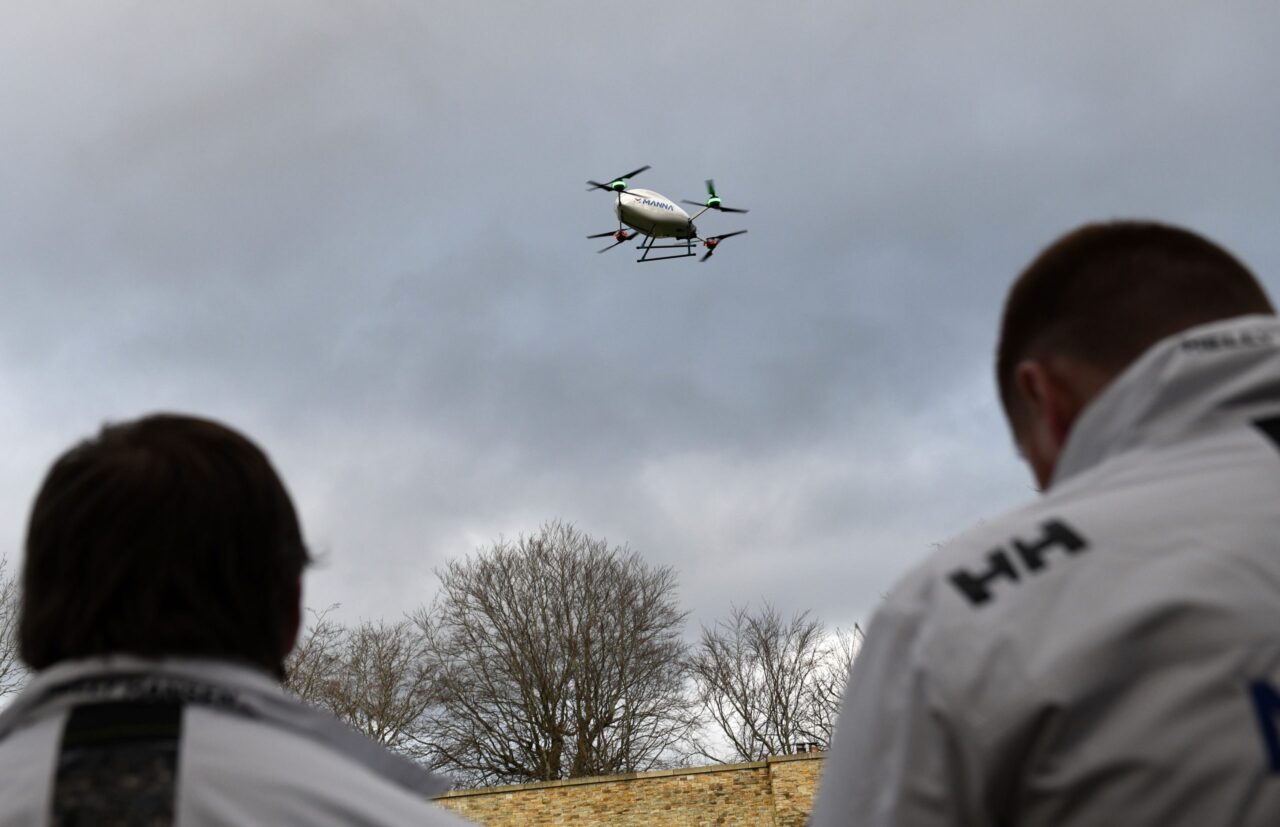
Hours after I met the students, Bobby Healy went public with the $50 million (€43 million) series B fundraise he recently closed for Manna Air Delivery. Manna’s existing business in the Dublin suburb of Blanchardstown “is by far the biggest drone delivery operation in the world,” according to Healy. “It is the most complex, the highest throughput, the most efficient and the only one that is making money in the world,” he told Tom.
He explained how the future-focused US VC firm Ark Invest came to lead this round for Manna, having seen its Blanchardstown operation and understood its potential to scale. There have been well-publicised teething problems with Manna as local concerns over noise and privacy echoed in a regulatory vacuum, but Healy was positive about government engagement. “We have a lot of risk around our growth in Europe and in Ireland because of this grey area. I think the answer is in the new National Drone Framework but this is only six or so months old,” he said.
It is no accident that both Manna and Iona are locating some of their expansions in the Limerick-Shannon area, where industry and academic expertise have evolved from the region’s aviation history into the Future Mobility Campus where companies develop various types of autonomous vehicles.
Iona is now benefiting from the capacity that the Irish regulatory system has developed in dealing with Manna. Where a drone company wants to try a new technology, the Irish Aviation Authority responds within 30 days, whereas other jurisdictions take up to six months, Louvet said.
Both entrepreneurs are realistic about their ambitions. Manna will not replace Google or Amazon, which are both developing their own short-haul drone delivery systems, but Healy says this market will be large enough for many more players.
Likewise, Louvet does not intend to compete with DPD or UPS, but rather to sell them the technology they need to cut the cost of van deliveries to remote rural addresses. His model is Stripe, the company my colleague Ian recently described as having “created the plumbing of global e-commerce” (rather than selling any products to consumers) to become a $140 billion-valuation business.
Ireland can become the home for innovators to develop and showcase the technologies and companies that will serve this growing global mobility market – not just with drones. Autonomous taxis, for example, have so far remained the preserve of large corporations in equally large cities, where there is, in fact, little need or road capacity for them. Public transport, walking, and cycling simply do a better job in busy urban contexts.
Yet there is ample road space and a population underserved by public transport across rural Ireland, where early community engagement and flexible regulation could allow the trialling of the self-driving vehicles that will one day transport and resupply the inhabitants of isolated homes and communities around the world. The Shannon campus already includes a high-tech testbed where experimental robotic cars and vans can drive around several kilometres of connected roadways.
Whether Irish or international companies end up dominating this industry, inviting them to grow, test, and demonstrate their vehicles here would benefit an entire ecosystem around them.
*****
Elsewhere this week, The Currency’s columnists continued to analyse the fall-out from the war in the Middle East. Dan compared the current energy shock with that caused by the 2022 invasion of Ukraine – somewhat favourably. Tara had some useful advice for business owners on how to deal with the jump in fuel costs. Constantin, meanwhile, looked deeper into the ramifications of the crisis for US bonds, and found starker prospects for interconnected financial markets.
Our scrutiny of the multi-billion-euro outsourcing of social services by the State included Niall’s trawl of documents related to the termination of 22 emergency accommodation contracts for international protection applicants. Meanwhile, I analysed Tusla’s purchase orders for 2025 and found that the leading private operators of children’s homes made a lot more money. Some new entrants emerged, including the McEnaney family.
As a recruiter, Paul was sceptical about personality tests for candidates but he put himself through the process and discussed it with Ryne Sherman, the chief science officer of the US HR psychology firm Hogan Assessments. Here is what he found.