Stories

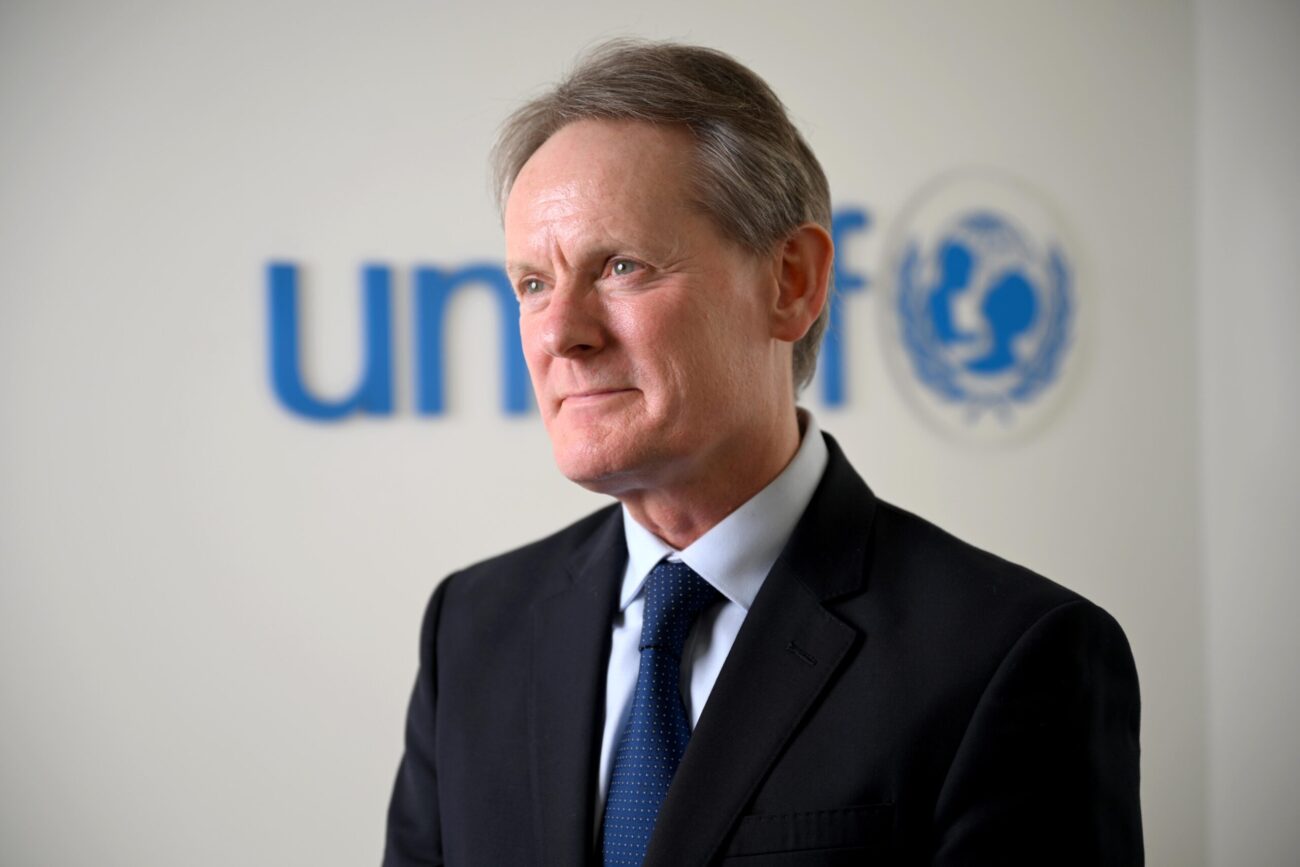
For the past 14 years, Peter Power has been leading UNICEF’s Ireland operation. It is an outpost that has had an outsized impact on the non-profit that tackles humanitarian crises across the world.
This was perhaps never more evident than when it came to fundraising to help respond to the devastation that has taken place in Gaza in recent years.
“The Irish people and Irish companies have been among, if not the, most generous in the entire world when it comes to providing humanitarian support,” the UNICEF Ireland executive director tells The Currency from UNICEF’s offices on Ormond Quay in Dublin.
UNICEF Ireland has raised over €34.8 million for Gaza from private sector donors since 2023 and more than €17.9 million for Ukraine since 2022.
UNICEF is an apolitical United Nations agency mandated to protect and advocate for the rights of children. Its global programmes include health, nutrition, education, protection, and humanitarian action.
The organisation is currently responding to an array of crises across the world, including in Gaza, Sudan, Ukraine and Afghanistan.
When Power speaks to seasoned UNICEF staff on the ground about Gaza, their report back is stark.
What distinguishes Gaza, they say, is not only the severity of deprivation, but its breadth. An entire population is pushed to the brink, with limited access to food, clean water, healthcare or safe shelter. Most hospitals are only partially functioning, and families are living in overcrowded, unsanitary conditions that are driving further illness and vulnerability.
“The central point about Gaza,” Power says, “is that this is no longer just a humanitarian crisis. It is a systemic collapse, an absolute catastrophe.”
Power, who was once a minister of state in the Department of Foreign Affairs, says that the damage that was done to the built infrastructure was “absolutely enormous”, adding that almost no hospital is fully functioning and that much of the water system has been devastated.
“If there isn’t access to clean water in a humanitarian crisis, everything falls apart. And that’s what did happen in Gaza,” he says.
“The health infrastructure was destroyed. The water and sanitation infrastructure was destroyed. In other words, there was just, I hate to say it, raw sewage everywhere, and they said it is absolutely desperate conditions to work in.”
Power says that 100 per cent of the children in Gaza have been “psychologically damaged” by living in the middle of a war zone.
“That’s something that we cannot emphasise enough. In most humanitarian crises, I would say practically every humanitarian crisis, there are exit points,” he says.
“If you haven’t been killed, you can get away. You can walk away from a famine, or you can walk away from a hurricane after it’s over, obviously, or a flood, a tsunami or this or that. In Gaza, there was no escape.”
A game changer
Power is speaking with The Currency as UNICEF promotes its Child Nutrition Fund (CNF), a global initiative that aims to drastically scale up the delivery of nutrition programmes, policies, and supplies to end “all forms of child undernutrition”.
Designed to address longstanding gaps in how nutrition programmes are financed and delivered, the CNF pools donor funding to scale proven child and maternal nutrition interventions. It leverages matched financing to incentivise domestic government investment in nutrition programmes.
The idea is to move countries away from reliance on aid towards co-financed, nationally owned systems. Funding is also linked to supply chains and local production for nutrition products such as therapeutic foods, with an aim of reducing dependence on imports and improving reliability and cost over time.
The use of ready-to-use therapeutic food – of RUTF – plays a crucial role in UNICEF’s efforts to supply nutrition to children and its continued delivery will be funded by the CNF. RUTF, which marks its 30th anniversary this year, is a small sachet of fortified peanut paste and has been widely regarded as one of the best tools to tackle starvation and malnutrition for children under five.
RUTF has a very high success rate when it comes to treating starvation with a recovery rate of 90 per cent for those suffering acute malnutrition. It provides 500 calories per sachet, enabling children to add weight and build up immunity during treatment. UNICEF is the largest producer of RUTF in the world, delivering 8.7 billion of the life-saving sachets between 2003 and 2025.
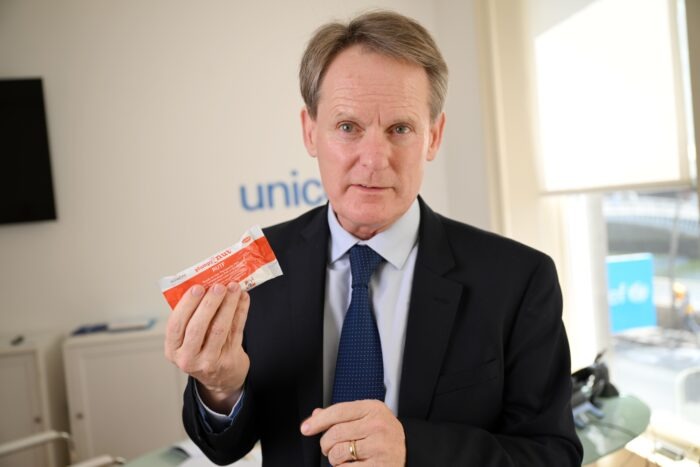
“This has been a game changer, and it saved countless lives,” Power says, adding that the paste is a “magic formula” to fight starvation.
“I’ve seen the incredible impact of this with my own eyes, what it can achieve on the ground. So up to now, it’s, it’s true to say there has not been a globally strategic approach to deal with under nutrition – call it what it is, starvation,” he says.
“But the Child Nutrition Fund is an entirely new and innovative approach, which brings together all the actors in the humanitarian space under one umbrella, led by UNICEF.
“The great news is that for people in Ireland who support the child nutrition fund… [they] will have their money doubled before the end of 2027 for the CNF by a philanthropic partner of UNICEF. People can have twice the impact of their support. With a USD$1 billion global target, there is effectively no cap on donation amounts eligible to be matched. ”
Irish Aid has already contributed €10 million to the CNF and Ireland is recognised as a global leader in the fight against hunger and malnutrition.
Irish people have traditionally shown huge empathy
When asked why he felt Ireland had made such significant donations to UNICEF and other charitable organisations, Power says that “Irish people have traditionally shown huge empathy”.
“But the fact that two million people were trapped in a humanitarian crisis and unable to escape. That seemed to strike a chord with Irish people, a deep, deep chord. It hit home at a very deep emotional level with Irish people,” he says.
“People, companies and philanthropists responded in a way that I’ve never seen in all my years, either working as minister for international development or with UNICEF, I’ve never seen a response like the response there’s been for Gaza. So Irish people can be enormously proud, enormously proud of what they have achieved in Gaza in terms of providing clean water, a huge polio vaccination campaign, education.”
He says that UNICEF was able to ship “enormous amounts” of RUTF to Gaza in recent years. Power says that therapeutic food for children was just one element of the aid UNICEF delivered to Gaza, which also included medical supplies, neonatal supplies, and clean water.
RUTF will also play a key role in Sudan, where almost 19.5 million people are facing violence and severe hunger with around 12 million who have been forced to flee. It is the largest humanitarian crisis in the world. Power will be travelling there in the coming weeks.
“Last time I was in Sudan, it was just really incredible to talk to the to the logistics and supply guys in the UNICEF team who would have to negotiate up to over 10 security roadblocks to get from sort of safe areas into Darfur and into conflict zones to bring RUTF into the most affected areas,” Power says.
“The United Nations declared a famine in Sudan last year and the most recent report indicates that 14 hotspots, including Darfur, are determined to be at risk of famine in the coming months”.
Power describes RUTF as “our number one tool in the fight against famine.”
Focusing minds
One of the challenges that humanitarian organisations face is maintaining the public’s focus on areas in dire need of support at a time when so there are so many crises ongoing at once. Power says that the reality is that the organisation is responding to an “omni crisis of enormous magnitude”.
To make matters more complicated, there have been a swathe of cuts to government budgets for overseas aid. In July of last year, USAID closed it doors for the final time after it was dismantled by the Trump administration. Britain also implemented its own budget cuts to foreign aid with spending by the UK dropping to its lowest level since 2008 last year.
For Power, the cuts are having a significant impact, adding that some countries have reduced their budgets by over 50 per cent. He points to the US and the UK but also to Germany, the Netherlands, France, and Italy.
“Ireland is an outlier, and it should be said Ireland as a country, Ireland as a people, and Ireland as a government all three have really stood up for the values that we cherish as a country,” he says.
“It is something I feel passionately about both as a former minister in for International Development, but as head of UNICEF here in Ireland, at the moment, the Irish people have stood whole and have stood proud when everybody else is scaling back humanitarian assistance.”
In addition, in some countries – especially the US – the drive to reduce overseas spending has been informed by protectionist regimes that have won favour by promising to reduce the number of people coming to their countries. However, as global conflicts continue, will pulling aid not ultimately lead to higher migration?
“There’s a huge short sightedness in that approach, because these countries are not far away, the world is tiny, and we have seen that if we do not support the development in under-developed countries, and those problems will come home to roost for the developed world,” he says.
“I have seen that for almost 20 years now, and it’s very short-sighted. It’s lacking in any long term strategic understanding of how the world works. But again, I would really emphasize, Ireland has been an outlier in terms of maintaining our ODA, we have been fantastic, and we can be proud.”
Power adds that the cuts that have been made have “cut deep” and says that if a finance minister cut five per cent of a budget it would be a “huge story”. But, he says the cuts made to development aid are far beyond those levels.
“There is no getting away from the fact that cuts at this level have effects, serious effects on the ground, and it affects UNICEF’s ability to deliver,” he says.
“And it affects practically every NGO international aid agency in the world. It’s affecting lives all over the world, no question.”
Power recalls meeting a woman in Dollow in Somalia who arrived at an internal displacement camp near the Ethiopian border. She had spent five days walking from her homeland, was exhausted and had lost two of her children along the way. When he met her, he asked, through translation, when she felt she would be able to back to her homestead again once she had received aid.
“I’m paraphrasing but she looked at me in the eye – and this is not someone who’s an expert in climate change or anything – and she said ‘there’s no going back, my land is dead’,” Power says.
“It made a huge impact on me.”
Getting the real message out
UNICEF is also responding to crises at a time when the proliferation of misinformation and disinformation around ongoing conflicts has increased substantially. In the case of Gaza, the United Nations Relief and Works Agency (UNRWA) said that it had intensified. The agency said that the Israeli government had “continuously made unsubstantiated claims against UNRWA and its neutrality” after the outbreak of the war on Gaza, which it said put the lives of its workers at “serious risk and harmed the reputation of the agency”.
For Power, he says there is a “huge amount” of disinformation – “lies” – distributed around conflict zones and that there is “no doubt that people’s views are being affected” by it. He adds that a huge part of his job is to ensure that the “real message” gets out there by bringing information from actual UNICEF workers on the ground to the people of Ireland.
“It’s a huge part of my job to convey to the Irish people what’s happening around the world and the impact, the real impact which Irish support is having… Again, I’m in the privileged position for I actually get to see the impact,” he says.
“I actually go out and I can see the UNICEF people on the ground, I can speak to our field and logistics operatives in Sudan who are specialists at negotiating with multiple armed forces across multiple conflict zones in the same country to get humanitarian aid across.”
“I’ve seen things that would make anybody cry”
Working from UNICEF Ireland, he brings a distinctive perspective shaped by regular travel to humanitarian crises — often in the developing world — before returning home. He says the contrast can hit hard.
“When I’ve come back from UNICEF missions, the contrast between what you’ve seen 24 hours ago and the incredible privileges we have here in Ireland. The contrast can hit you real hard, real hard. At an emotional level, it can hit you really hard,” he says.
When asked what drives him he says: “I have seen things in the field that would make anybody cry, the hardest of hearts break, the saddest things you can possibly imagine, and to be involved in an organization that responds a huge scale and with huge impact, being part of an organization that can achieve impact at enormous scale, such as in Gaza, Ukraine, Sudan, Yemen… is just incredibly fulfilling, and it’s life changing.”
Despite the horrors he has seen, he says he is an optimist and always has been by nature. When asked if he’s optimistic for the future, he says that he is because he believes the people of the world want peace.
“People want their children to survive, they want them to survive and thrive, and they want their governments to create the conditions which allow that. So to that extent, I’m an optimist, but I’m also a realist,” he says.
“There are some real bad actors in the world, and the real challenge is to ensure that good overcomes evil. The vast majority of people in the world are good. They want what’s best for their children, and evil has to be challenged at every single point in history, and history has borne that out. Evil has to be stood up to and challenged.”
This article has been produced in association with UNICEF Ireland.