Stories

Richard “Rick” Hough vividly remembers coming out of the subway and walking up Fifth Avenue to work.
“It was the most perfect day,” he recalls. “September in New York is often gorgeous. Low humidity. Not a touch of cloud in the sky. I was a little later than usual and people on the street were all facing downtown. I was walking up but they were all looking down. I could see a black plume, but couldn’t quite tell it was the Twin Towers.”
Hough was in his early 30s, and working in a successful non-profit raising hundreds of millions to educate American under-privileged children, so he hurried to his office and turned on the television. His brother was working in a law firm near the intersection of Park Avenue and 39th Street, and he could see the towers out of the window of his conference room.
“Phone lines were overwhelmed but we managed to get on the phone. My brother was just gasping, yelling. There was a delay on the live feed compared to what he saw. He said: “God, the second building is falling.” And then I saw it on TV.” Hough met up with his brother, and they went to a hospital to give blood. “There were no casualties to treat. It was all fatalities.”
Hough walked three miles through Manhattan hoping to find a way home. “I passed one car. One bus. That was it. Nothing. I saw maybe three people. Everyone had gone into their apartments. There was then something I had never experienced before or since. There was just this hum that you never hear. It was the infrastructure of New York City.”
He got on a ferry which docked at Wall Street, and all the passengers were silent, shell-shocked: “They had thousand-yard stares. Eventually I went home and learned slowly over the days about friends who died or children who lost their fathers … I had two children and a third on the way. It made me reassess everything and really accelerated my thinking about what to do next.”
*****
Richard Hough is telling me about his memories in a boardroom just off Fitzwilliam Square. It is September, 25 years later. Hough is in Dublin as the wealth advisor he leads, Silvercrest Asset Management, opens its first European office, after signing a 10-year lease on a prestigious office on Northumberland Road in Dublin 4.
The office is not quite ready, so we meet in a serviced office where Silvercrest has been based as it applied for and successfully obtained a full MiFID licence from the Central Bank of Ireland, allowing it to expand its international growth into Europe.
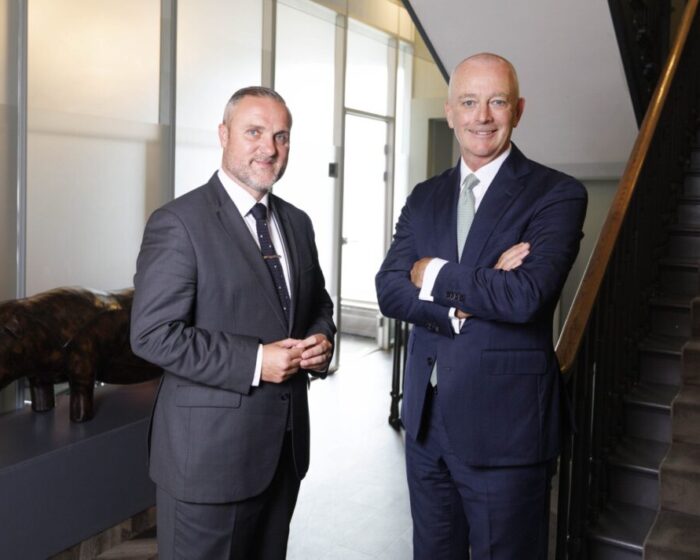
In the floor below our meeting room is Fintan Maher, the new head of Silvercrest’s business in Europe. He previously led Goodbody’s family advisory business and worked for Declan Ryan’s family office, Irelandia.
Colm Galvin, who previously founded a Dublin-based multi-family office business and spent 18 years with Bank of Ireland, culminating in his role of head of US markets and treasury, is also downstairs. Hough was out the previous night at the Dublin Theatre Festival, which his firm sponsors.
He admits to having a few pints of Guinness in O’Donoghue’s on Merrion Row, but he shows no signs of tiredness, other than he drinks two coffees during our interview.
Hough’s love of Irish culture stems from being taught while in prep school in Massachusetts by Seamus Heaney before the poet became a Nobel laureate. He has led Silvercrest since 2013, and helped build it into a wealth manager with $25 billion (€22.9 billion) in discretionary assets under management.
He now sees Dublin as its beachhead to Europe, but how did this Princeton graduate of philosophy and politics, become an atypical CEO of a fast-growing wealth manager?
The Bush Whitehouse to Walmart
Richard Hough seemed destined for a career in public service and non-profits. He had interned in the George H.W. Bush White House while an undergraduate specialising in education and drug control policy. He graduated in 1992, just as the 41st President of the United States lost his bid for a second term to Bill Clinton.
Hough and his friends in the Bush administration were all fired in 1993. He was 23, and winging it in Washington, writing speeches and policy analysis about education. He could see how many underprivileged children in Washington were missing out on going to good schools, so he became a founding board member of a new non-profit called the Washington Scholarship Fund.
“It provided scholarships for low income children and their families to send them to schools that they couldn’t afford,” he says. “It was for families who wanted something better for their kids. It was the height of the crack epidemic in Washington and our primary purpose was keeping children safe.”
The fund rebranded as the Children’s Scholarship Fund when it went national, and Hough became national programme director in 1998. The fund was set up by a legendary investor Ted Forstmann and his friend John T Walton, a son of Sam Walton, the founder of Walmart.
It has raised over $1.2 billion and educated a quarter of a million children to date.
Hough became friends with Forstmann, who died in 2011, and famously coined the phrase “the Barbarians are at the gates” in the 1980s, meaning what it meant for a company to be taken over by private equity in a buyout.
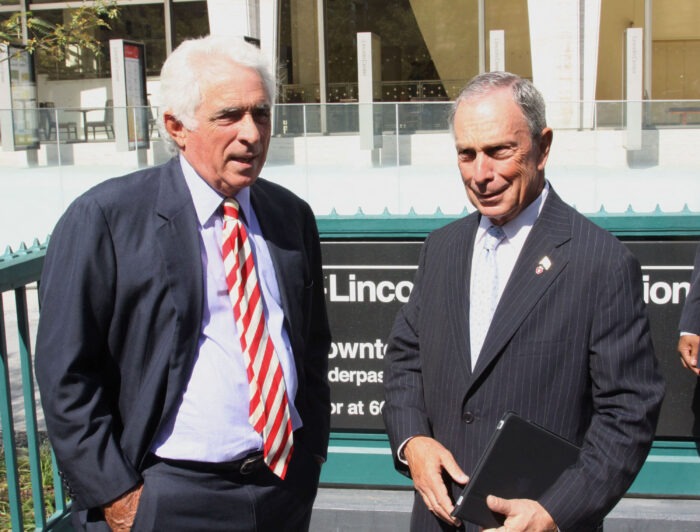
“Ted was a very famous investor on Wall Street,” Hough says. “He became our chairman and really energised us with a very large donation and opened up his Rolodex to his friends and other folks.”
The late John Walton, who served as a Green Beret in Vietnam and was a partner in Truth North Ventures, also became a friend. “John was extraordinarily generous and important, as has been all his family, to our efforts,” Hough adds.
Hough also founded and worked with two other non-profits: “One had a substantial tech bent, which became part of America AOL. The other one is quite different. It was an organisation working on liturgical scholarship, translations, and music in the Catholic Church. So I had a very unorthodox background.”
While Hough was with the Children’s Scholarship Fund it expanded into 40 cities and educated 60,000 children. “It spread like wildfire. I was working six or seven days a week. We raised I think by the end of ’98 maybe mid ’99 something like $250 million,” Hough says.
“It was a lot of money then and very rapidly we were probably the fastest growing non-profit in America. It was so energising and fun to build something, and so exciting to work with probably my best friend Douglas Dewey to build it out together and to have an effect on these families,” he says.
“We had all of Silicon Valley supporting us. Innovative legends like John Doerr [a renowned venture capitalist at Kleiner Perkins]. Arthur Rock [an early investor in Intel and Apple] gave us a lot of money. It was absolutely amazing the enthusiasm for what we were doing. It was so successful but now we were managing this infrastructure and maintaining it and helping all these families.”
Hough’s role was becoming more managerial and he started to think about leaving – a feeling that crystallized after 9/11. With Dewey, he produced a new business plan which wrote them both out of the non-profit: “It was the right thing for the organisation. I was kind of burned out. I didn’t talk to Douglas about this but I think he was too. It was a good grind, but a grind.”
He was 32, and out of a job.
The birth of Silvercrest
Martin “Marty” Jaffe and Moffett Cochran were veterans of Wall Street. They both had jobs that paid them millions of dollars a year but they too were restless. They’d been working together in a well-known Wall Street brokerage called Donaldson, Lufkin & Jenrette (DLJ) which was founded in 1959 and known for its independence, unconflicted research and being the first brokerage to list on the New York Stock Exchange.
“Marty and Moffett both had huge jobs on Wall Street,” Hough says. In 2000, Credit Suisse acquired DLJ for $11.5 billion and Jaffe and Cochran were put in charge of Credit Suisse’s Asset Management division. “It was at the time the largest asset manager in the world,” he adds. “But they didn’t like working for Credit Suisse. In fact, they hated it. I wouldn’t tell you that other than Credit Suisse no longer exists [after it collapsed in 2023 and was bought by UBS to prevent its bankruptcy.]”
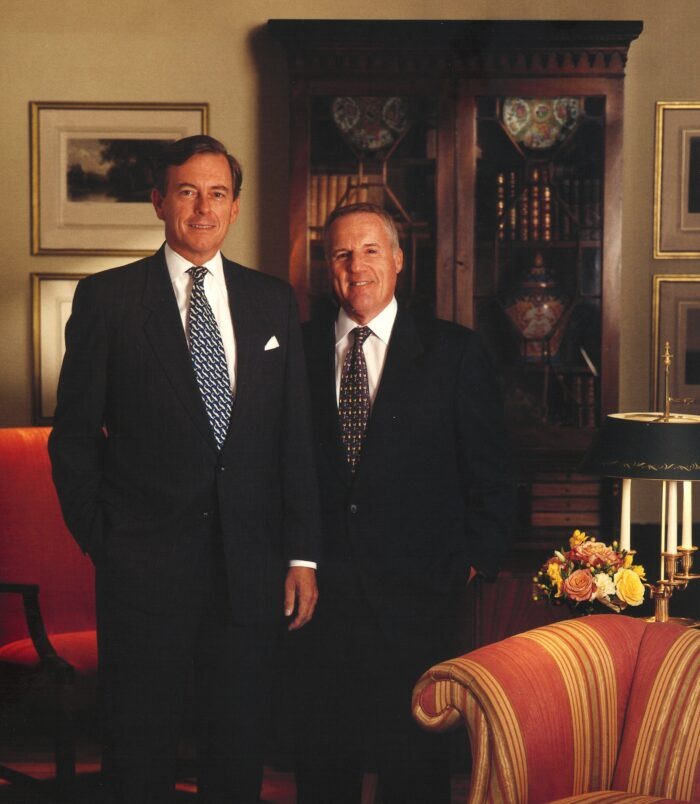
Jaffe and Cochran decided to set up their own firm. They called it Silvercrest Asset Management and took around 25 of their team with them.
“Credit Suisse lost all of the talent they had bought and ultimately they ended up writing off that entire investment,” Hough says. “In fact, when Credit Suisse itself disappeared it was worth less than what they had bought DLJ for some 25 years before.”
Silvercrest was founded at an inauspicious time for finance in the wake of the tech bubble collapse, 9/11, mega-merger disruptions, and weak markets. “There was a sort of existential crisis,” Hough says. “The environment in which we were founded was really important. There are current trends in our industry that I believe are repeating themselves in the United States in that back then large conglomerate banks were gobbling up each other and today wealth managers are being bought up.
“Companies were operating under the premise that more and more scale would create greater presence allowing businesses to grow to become dominant players. That is what happened when Credit Suisse bought DLJ right at the top of a bubble.”
Silvercrest’s founders were determined to get its fundamental rights, not chase growth for growth’s sake, and focus on giving its clients the best advice. “Our founders wanted to create an independent firm that was focused as a fiduciary on really excellent asset management capabilities that would serve ultra-high-net-worth clients and families.”
Jaffe and Cochran were determined to avoid conflicts of interest when given advice, which they felt they’d experienced when they were part of Credit Suisse.
“They didn’t want to do investment banking or any form of banking,” Hough says. “This was an innovative idea at the time. A core principle was – and is – to always do the right thing by clients. Clients’ best interests always win.”
Turning down Lazard Frères
After leaving non-profits in 2002, Richard Hough started to look around. He had a good network from his time with the Children’s Scholarship Fund but didn’t know what he was going to do next. His friend Forstmann and another investor called Julian Robertson, who founded Tiger Management, one of the world’s first hedge funds, introduced him to potential new employers.
Hough had an interest in wealth management from his university days and after so much market turmoil felt there had to be a better way to invest people’s money. “I felt that in the wake of 9/11 and the tech bubble and during very bad and chaotic markets someone would be starting a firm,” Hough says. “I literally had that thought: ‘This is what happens.’ The banks have all consolidated and they’re going to start breaking up in different ways – so someone’s going to challenge it.”
He had, as it turned out, picked up some useful skills: “I understood statistics and had the ability to simplify complex ideas and write well. If you think about what we do in wealth, you’re translating a lot of concepts to people. You’re explaining them. You want your client to feel comfortable with what you’re doing. Am I the world’s best quantitative person? Absolutely not. In some ways it is an advantage to be a generalist. So I packaged that for Wall Street and hoped someone would take a chance on me. Also I’m very cheap – as I’ve just come from non-profits.”
Hough ended up with two job offers. One was with Lazard Frères, a storied wealth management firm founded in 1848 by three French brothers. “I was pretty pleased I got a job offer from them. It was very enticing,” he says.
A friend of a friend had also introduced him to Silvercrest. “I really hit it off with Moffett [Cochran, Silvercrest’s first CEO]. It was new and very entrepreneurial. Moffett didn’t have a job opening but I think he saw something in me he liked.”
He was asked to write a business plan for Silvercrest, which was circulated around the firm and “there were no corrections”. He was also interviewed by people at every level of the business, a practice Silvercrest continues in its hiring today. “It’s part of the culture buy-in,” Hough says. “I didn’t know it but [Cochran’s] board wanted him to hire a right-hand person who could help him execute the business.”
Hough came in as a vice-president: “The bottom of the totem pole. I didn’t get the same feeling from Lazard. I was kind of turned off by how big it was, so I turned it down.” But what really tipped him over was when he noticed a Silvercrest brochure sitting on the radiator of one of Lazard’s senior team. “I thought, ‘That’s interesting.’ I took it as a sign.”
Wealth in a time of crisis
Moffett Cochran was more than a talented wealth manager. His father George Moffett Cochran was a Virginia Supreme Court justice who spearheaded the movement for desegregation in his state. Cochran followed his father into the law, and he was a talented fisherman, hunter, and artist. “Moffett was a very good and savvy businessman,” Hough says. “He was 52 [when Hough joined] so he was younger than I am now. I looked up to him as a mentor.”
Silvercrest had $1.2 billion under management when he came on board in mid-2003, but it was growing fast and reached $1.6 billion later that year.
From the start Hough liked working in Silvercrest. “If you want a long, sustainable career, work with people you want to do work with and do your best to measure them up against the principles of the firm,” he says. “One of our principles is to have fun. People spend their careers in Silvercrest for a reason. Our average tenure is 12 years. We have a 98% retention rate for our clients, but as important is our employee retention rate. We provide one-on-one very careful, personalised relationship-based advice. You have to really know somebody well to give them great wealth advice.”
For Hough, wealth management was not just about good asset allocation: “What is a differentiator is knowing your clients and families well and being able to customise things for them. When you’re dealing with families, it’s all deeply personal.”
Under Cochran, Silvercrest grew steadily, but its real test came during the financial crash of 2008. “Our clients did extraordinarily well in the global financial crisis,” Hough says. “We have a quality bias. When you’re dealing with wealthy families you have a clear fiduciary duty to help them preserve capital. Everyone wants growth. It’s great to make money, but you can’t forget you can’t lose capital. These families have worked so hard to make their money.
“On a relative basis, did we go down in the financial crisis? Absolutely. But we didn’t go down as much. We preserved a lot of capital, and it came back because of its quality.”
Silvercrest did see its cash flow squeezed during the crisis, but it wasn’t leveraged. “We had none of the Wall Street problems at all because we’re not in those risky businesses. But you’re still exposed and our revenue is levered to the markets through our clients. We’re on the same side of the fence as our clients.”
Silvercrest’s low-risk investment in quality assets meant its clients recovered faster than others, and referrals started to flow in. Our business really took off after that,” Hough says. “It was a huge test for us and the trust of our clients but we performed relatively well and we were able to capitalise on that. High quality preserves value in big downturns.
“The crisis really was where I made my bones working for Moffett, as managing through that was such a formative experience.”
Becoming CEO
Richard Hough then started to move up in Silvercrest. He joined the firm’s operating committee in 2006, so he understood its nuts and bolts, and by July 2010 he was its chief operating officer three years ahead of its listing on the Nasdaq. Hough had no plans to become CEO, and he knew Moffett Cochran had a neuroendocrine tumour on his pancreas and then his liver.
His friend had survived nearly a decade since his diagnosis, and shown incredible resilience. As 2013 went on, however, things worsened, and his friend started to die. “It was extraordinarily hard to follow in the shoes of a visionary leader who tragically died. It was very hard to go through that with him and his family,” Hough says. When Cochran died in November 2013, he took over.
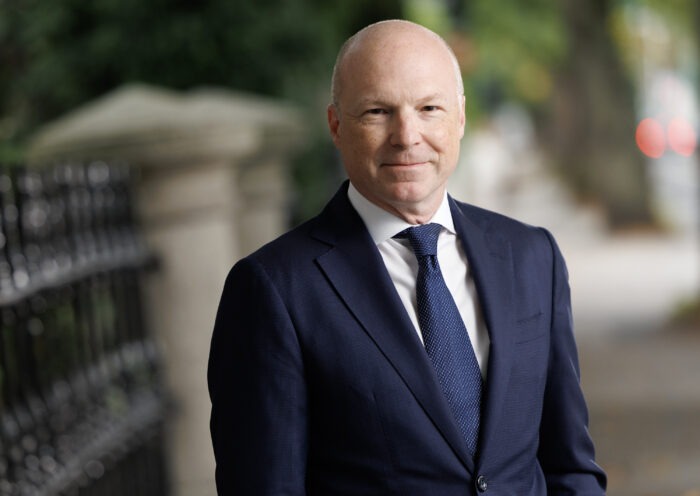
In his first meeting that December as chief executive Hough recalls telling his team: “Moffett’s dead. He built this company. But I just need to be clear, I’m not Moffett. I’m not going to try to be Moffett.”
He realised he had to be his own man, while respecting his mentor’s principles and vision. “I didn’t appreciate how big a change it was becoming CEO,” he says. “I didn’t appreciate all the things that Moffett was doing for our business in his corner office quietly. It took me a couple of years to figure out how to lead and I’m still figuring that out.”
Ireland as a European beachhead
When Silvercrest listed it had offices in New York, Boston, and Charlottesville. Today it has eight offices in the United States, an office in Singapore, and professionals in London and Australia. About two years ago Silvercrest started to look at opening a full office in Europe.
“From day one we’ve had European clients,” he says. When it came to opening a European office, Dublin made sense. “London’s not in the EU. There is a huge amount of talent in London, but as a business it does me no good to help my European clients.”
Silvercrest had clients in Germany, Poland, Switzerland, the Netherlands, and a few other countries. Its clients in the United States, Asia, Australia, and South America all wanted access to Europe too. “More and more Americans want to be exposed to Europe,” he says. “All vastly wealthy families want to have European exposure as part of what they do.”
Having a European office would allow Silvercrest to meet its clients here more: “Money is stressful for everybody. No matter how rich you are. If you have a concentration of clients and an opportunity to work with them then it makes sense to open an office nearby.
“We felt families in Europe could use us and that we can help them. I think it will give them comfort, just as it does our US clients, to be closer and to be fully regulated in Europe.”
Silvercrest employs 175 people, including five in Dublin so far, and it has a 5:1 client-to-professional ratio. The firm’s private client business offers institutional-quality investment management alongside financial planning, tax-aware portfolio construction, and other services.
It also has an asset management business working with institutions like pension funds and foundations. On average, its employees have worked in wealth management for 25 years. “There’s a long apprenticeship in this business,” Hough says. “The only way you can work credibly is if you have meaningful experience.”

Ireland made sense as a European base. “It has very well-developed and mature business infrastructure,” Hough says. “It has a good regulatory environment and it is English-speaking.”
Silvercrest had a new global equity strategy that was seed funded by a large institutional Australian investment and this needed a European licence. “We want to bring it to institutional investors in Europe so we need to be in Europe,” Hough says. Ireland also had a domestic wealth management market which Silvercrest wanted to serve.
“We have hired Irish people who are embedded here and know what Irish wealth wants and needs. I think a lot of American firms fail in Europe because they parachute in Americans or acquire something without thinking about the cultural fit and taking the time to build for the long-term.
“We can provide our clients with a holistic, comprehensive wealth solution that can complement existing family offices or be the commercial family office of a wealthy family. There has been massive wealth creation in Ireland. We are seeing families who have worked really hard to build businesses seeing a lot of liquidity and move from not just asset rich or business rich but cash rich.
“Our model of being a fiduciary with regards to advice only and with no other businesses is now ubiquitous in the United States and will be in time in Europe.”
Silvercrest is a bespoke firm and doesn’t have strict limits around how wealthy its clients need to be. “We like working with entrepreneurs and business builders who might have, say, €10 million but maybe they will have €500 million when they sell their company, so we want to start working with them now so they can get ahead of that. It’s not about being snooty or creating exclusivity about how much money you have.”
How wealthy is Ireland? “With regards to Ireland I think you’d be shocked how much money people actually have,” Hough says. “There are more billionaires and centi-millionaires than you know.
“Our business is one of quiet networking and relationships. I’m going to meet with a billionaire this afternoon. I don’t know if he needs us or not. That’s not the point, actually. It is about talking to him about what we do and listening to the needs of his family office. We may be able to provide a solution he can’t get in other organisations.”
Competing, the arts, and AI
A driver is waiting to take Hough to meet the aforementioned Irish billionaire in his family office. He doesn’t say which one, and our conversation is nearing an end. He tells me that Irish wealth advisor Tom Clinch has helped Silvercrest set up in Ireland. “Tom has been a good friend to us. He understands the pie can grow and we can all benefit. He’s in a different part of the market too, so we will work together and cooperate.”
Hough says Silvercrest also hopes to make a difference by supporting the arts in Ireland, sponsoring events such as the Dublin Theatre Festival and Blackwater Opera Festival. “We want to engage in the community in Ireland. A lot of people can do asset allocation. AI can do it. But good as that might look on paper, it may not work for the individual. You can only understand the individual by spending time with them – and understanding their city and culture.”
I ask Hough if he is worried about the markets overheating because of the wall of money going into AI. “The economy in the US is doing great by a variety of measures,” he says. “We tend to be positioned with a long-term view and an eye towards high quality. If we go through a stock market correction or deflation in the AI trade it will create chaos and maybe hurt our revenue. But I’ve learned, as from before in other crises, it will also create opportunity.”
How will Hough compete with other international wealth advisors already in Ireland as well as domestic players? “I compete with Goldman Sachs, JP Morgan, and all the rest of them in New York, which is way more competitive because of the amount of wealth that is there,” he responds. “Competition doesn’t bother me. It makes us sharper. We have a long-term vision and commitment to Ireland. Our clients are thinking in generations and so do we.”

