Stories

It took five months and more than 25 interviews to tell a story we’re calling Radio business, a four-part series that begins in The Currency tomorrow and runs for the rest of the week.
It’s about the Irish radio world beyond RTÉ. It might not get the massive media coverage afforded to the national broadcaster, but for me it’s a lot more interesting.
Every single person I interviewed spoke openly and honestly, in some cases with a degree of candour only made possible by the passage of time.
I’m biased, yes, but after 38 years in journalism I know a good quote when I see one – and this series is packed with them, as well as numerous colourful anecdotes. But, more than that, Radio business tells a story about a very important part of Irish life.
It really begins in 1989, when the first licences for independent radio were awarded after the airwaves had been dominated by pirate broadcasters. Consortiums were formed all over the country. The feeling among a lot of them was that a licence to print money was up for grabs. But it was also a chance to be part of something that would, over time, make a difference to the lives of so many people.
One thing I’ve learned from months of talking to people for this series is that the radio business gets under people’s skin, even with all the challenges it currently faces. The Radio business series also takes an in-depth look at where the sector stands today, and where it might be going next.
Over four days we’ll trace how we got from there to here – from the licence frenzy of 1989, to the boom years of the Celtic Tiger and then the 2008 crash, on to the changed landscape of 2026. It’s tough out there, there’s no doubt about that, but as one of those featured puts it: “‘Video Killed the Radio Star’ was a hit back in 1979 – and yet here we all are, still going.”
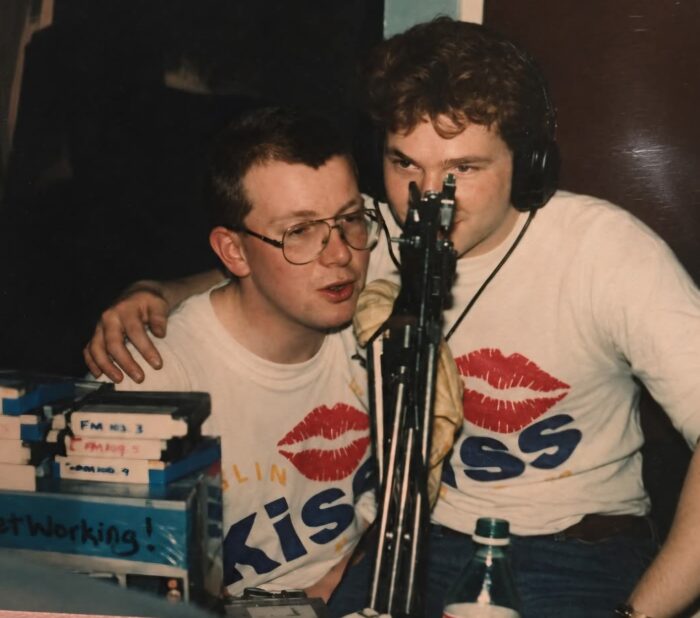
Video didn’t kill the two youthful pirates pictured below. These days Kevin Branigan and Mike Ormonde are major players in Irish independent radio, as owners of the increasingly ambitious Bay Broadcasting, which owns Radio Nova, Ireland’s Classic Hits Radio, and Galway Bay FM. It also has a big stake in the market-leading Dublin music station, Sunshine 106.8. The full story of how all that happened is told in Part 3, along with the inside track on the cautionary tale that was 4FM.
One of the hopeful applicants who ended up getting a licence back in 1989 was Denis O’Brien, then 30 years old. In his case, the money-printing part turned out to be true – and he also loved the excitement of it all. In a spin-off interview from this series, O’Brien recently told The Currency why he got out of the media business. But now, in hugely colourful detail, he talks about getting into it in the first place.
In Part 2, O’Brien tells the full story of how 98FM took off like a rocket in Dublin – and ultimately provided the platform for him to become one of Ireland’s richest men. He launched Esat Telecom on the back of the advertising revenue that poured into 98FM. As he puts it himself, they were “selling the bollocks off the radio station”.
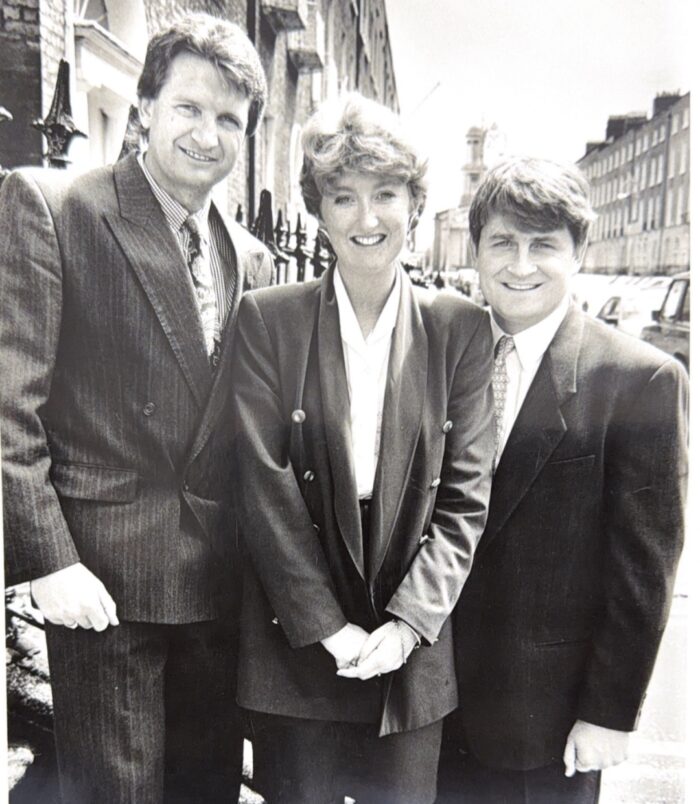
That’s him in the picture above, pictured with station director Jeff O’Brien – a no-nonsense Aussie – and Lucy Gaffney, who was newly appointed as sales and marketing director when they were photographed outside 98FM’s building on Upper Mount Street, Dublin. Gaffney is another of the interviewees and she, too, has plenty to say.
One reason I decided to tell this story was because my late father once had a job selling advertising for the station that won our local licence in 1989 – Radio Limerick One. I knew it didn’t start very well. What I didn’t know was that O’Brien almost took the station over after arriving in Limerick one day with a cheque for £10,000, his deposit on a 40% stake costing him £200,000. What happened next is told in Part 2.
More than two dozen other radio people from around the country tell their stories in the series, and countless others are mentioned along the way. Interviewees include those running radio stations with phenomenal market shares in their areas, far more than even the most optimistic observers ever envisaged when the whole thing started.
Rather than a full history, the idea was to write a fast-paced narrative featuring big characters and key storylines – the major deals that were done and the ones that fell through, the boom times and then the crash.
If you’d like another flavour of what’s in the series, you can listen to this podcast. I sat down in Dublin’s Beacon Studios with The Currency’s CEO Tom Lyons to give listeners a sense of what’s coming later in the week.
If you’re not already a member of The Currency and would like to read this in-depth series, now is a great time to join.
For the next two weeks only, new members will get a free Samsonite Upscape Spinner suitcase, worth €235. So for an annual membership of €200, you’ll get the suitcase plus our two premium services – The Currency and The Wall Street Journal. Anyone who has been reading it lately will know that the WSJ‘s reporting on the AI industry – the Nvidia scandal, the Anthropic float – has been must-read stuff. And, of course, The Currency has a brilliant team of hugely committed journalists.
If you already have a membership, the offer could make a great Christmas gift. It’s available for a limited time and the Samsonite suitcase can be delivered to any postal address in Ireland. Full details of how to avail of the offer are here.
If you do get to read the full series, I hope you enjoy Radio business. Many thanks to all of those who helped me to tell a hugely eventful and colourful story.

