Voices
I tend to avoid writing about the media.
Part of that reluctance stems from my five-year stint on the board of RTÉ, where I served as deputy chair and as a member of its Audit & Risk Committee. As readers of this publication will know, I neither edit nor pre-read any articles relating to RTÉ before they are published.
But my hesitation goes well beyond any conflict.
In truth, I have long felt that media discussions often become more about the industry itself than about its audience. Too often, it turns into Beltway-style, inside-baseball commentary. The media cares more about the media than people. We need to be above that. As an industry, the media is far too often navel-gazing. Readers, viewers, subscribers – they all deserve better.
This week, however, I am making an exception.
I am doing this not because I want to write about media, but because I feel compelled to. Because, quite frankly, the media minister, the Fine Gael TD Patrick O’Donovan, went far beyond his legislative brief, and far, far beyond what is acceptable as an elected member of our parliament.
O’Donovan is a cabinet minister. He receives his seal of office from the president of the country. He attends cabinet meetings and is, by virtue of his appointment, one of the most influential people in the country.
Last week, as rank-and-file citizens sought to deal with the barricades and the protests on the motorways they had paid for, O’Donovan sought to reframe the conversation.
He could have called out the tensions between the two main governing parties that made a bad situation an awful one. He could have been honest about the Government’s lack of foresight and lack of leadership in dealing with these protests. He could have done a lot of things.
Instead, he opted to turn his focus on the media. Anyone who has spent any time around Leinster House knows that the Limerick politician is not a fan of the media; he has been open and forthright about his views.
Last week, however, he went too far.
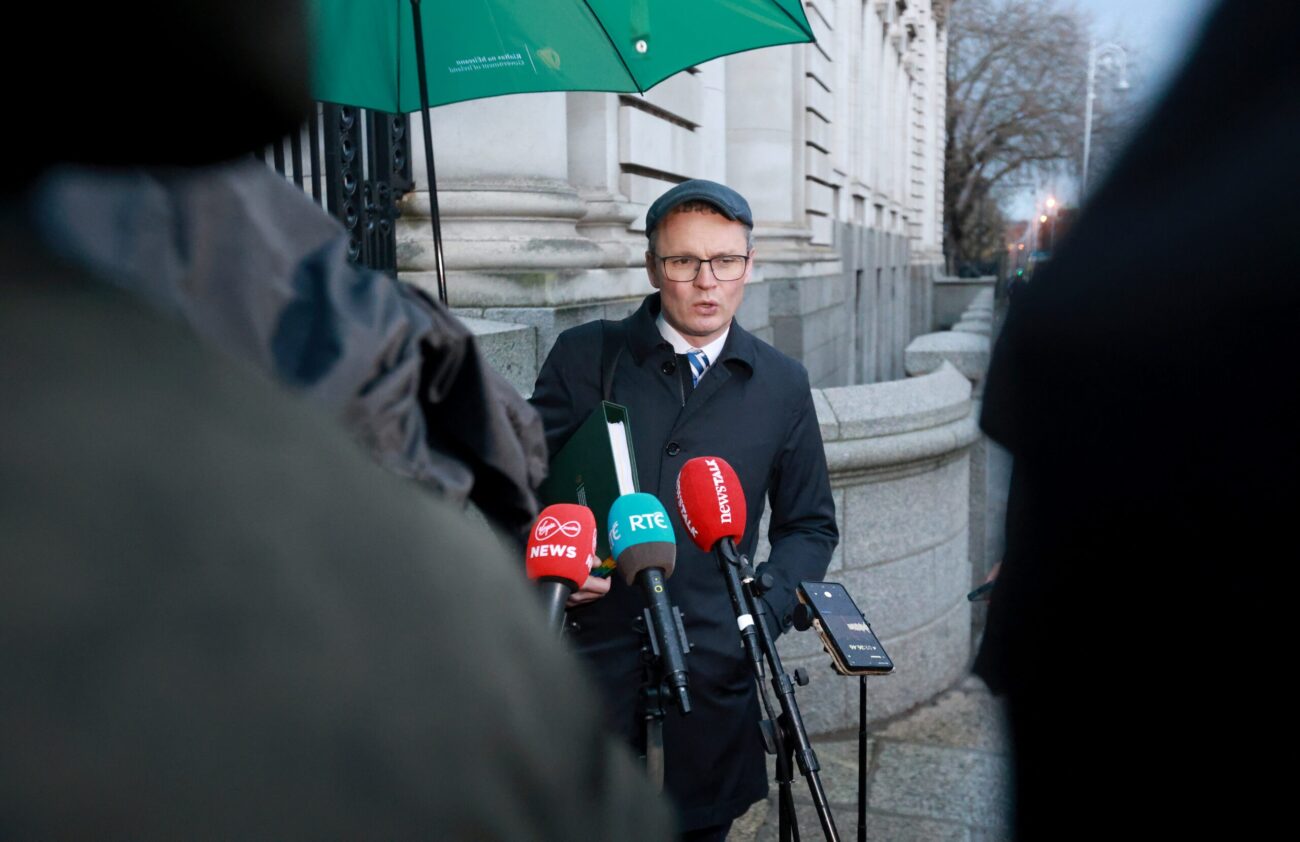
On Monday, during a round of interviews, O’Donovan said he felt RTÉ’s coverage of the fuel protests was one-sided. He pointed in particular to a report from the Whitegate oil refinery, suggesting it may have actually encouraged people to join the protests. He also said he plans to ask Coimisiún na Meán to take a closer look at how RTÉ and other news outlets covered the story.
O’Donovan said he would be asking if the coverage was “balanced or was it skewed and I think that’s a role for Coimisiún na Meán”.
“Coimisiún na Meán may turn around to me and say ‘Nothing to see here, move along, move along’, but I’m going to ask them the question anyway,” he said.
As various experts have since pointed out, there is no statutory basis for such an instruction. It exceeds his powers and his mandate.
His calls for an investigation were quickly rebuffed by his boss, Tánaiste Simon Harris. After a meeting with the regulator, O’Donovan withdrew his request.
But by that stage, the damage was already done. He had effectively shown his hand, revealing a level of mistrust in the media and a particular view of how news organisations were handling the story. He also sought to show supremacy over the media and independent media regulators.
In questioning the role and conduct of sections of the media, O’Donovan appeared to go beyond criticism and into the realm of insinuation. His comments raised the spectre of wrongdoing without presenting evidence, a move that carries weight when it comes from a senior figure at the cabinet table.
Ultimately, the issue here is not whether the media is beyond criticism – it clearly is not. The issue is whether those in positions of power exercise their influence responsibly. On that measure, the minister’s intervention raises more questions than it answers, and those questions deserve careful consideration.
Let’s take a step back and examine his ill-timed and ill-fated intervention.
First, his department oversees Coimisiún na Meán; it allocates its funding, and it determines its legal status.
Secondly, as minister, he brings nominations for the board of RTÉ to the cabinet. Yes, those nominations are shortlisted and vetted by the Public Appointments Service. In the case of RTÉ specifically, a number of appointments are proposed by the Joint Oireachtas Committee on Communications. But it is his signature that appoints the board, and it is he whom the chair of RTÉ engages with.
It is also his department that allocates licences for regional radio stations, and his department that sets funding for various Government-supported bursaries for things such as local government and court reporting (something I believe the State should not engage in – but that is the subject for a different column).
So, within the media, Patrick O’Donovan carries a lot of power and a massive amount of influence.
His comments might not result in an investigation into something that did not need to be investigated. But they are chilling nonetheless, as it sends a shot across the bow of boards and bodies he directly appoints and funds.
The National Union of Journalists was right when it described the remarks by O’Donovan as “sinister and deeply disturbing”.
Last week, we published a column by Susan O’Keeffe, the extraordinary journalist who investigated Ireland’s beef industry in the early 1990s. Susan needed to go to a foreign broadcaster in the UK to support and publish her investigation. The response of official Ireland was to investigate, arrest and jail her, as opposed to probing into the issues she bravely uncovered.
Surely we have moved on from this?
But the comments by O’Donovan also point to a deeper malaise about the direction of this Government, one that O’Donovan occupies a high-ranking role within.
Its handling of the fuel crisis, cackhanded and reactionary, was in keeping with its recent performance.
There is a lack of coherence to this coalition; one that can be seen in the lack of legislation being pushed through the Oireachtas or the fact that one of its junior ministers, Michael Healy-Rae, was more than happy to abandon ship and resign in protest over its handling of the fuel protests.
Governments can be lots of things. They can be ideological. They can be functional and bureaucratic. This one is neither. It lacks a political or ideological compass – this is partly due to the fact that it does not have an ideologically-driven coalition partner, and also to the fact that it has been in power for so long. As Gerard Howlin said on the radio last week, it lacks a big idea. It has stumbled through unconvincingly.
As I wrote last week, it opted to buy off the protests rather than engage in meaningful debate.
Patrick O’Donovan could have called for a review of the State’s handling of this sorry episode, where those who shut down the country were paid off handsomely.
Instead, he sought to blame the media. What makes this episode particularly notable is not simply what was said, but the position from which it was said. Cabinet ministers do not comment as private citizens; they speak with the authority of the State behind them.
That distinction matters, especially in a sector as sensitive as media, where perception and pressure often matter as much as formal direction.
Elsewhere last week…
After exposing corruption at the heart of Ireland’s beef industry, Susan O’Keeffe found herself blamed, arrested and discredited. Last week, she told her account of what really happened – and what Ireland chose to ignore.
Michael spoke with owners, operators and investors for a three-part deep dive on Ireland’s hotel sector. In part one, he detailed why Dublin dominates the supply of new hotel rooms and how clever financial initiatives like split mortgages could spur more development in the regions.
Part two focused on how the capital continues to absorb new hotels despite the thousands of new rooms that have entered the market in recent years. The Dean Group, now under new ownership, has grand plans for the city, while the arrival of The Hoxton and the imminent opening of the luxury Sofitel Hotel at Dublin Airport also speak to a buoyant market.
On Friday, for part three, he discussed how Ireland’s international reputation for hospitality will be watched closely as more institutional capital enters the market. Something that will be under particular scrutiny when the Ryder Cup rolls into Adare Manor next year.
Over 15 years on from its €4bn bailout, PTSB is set to leave State control. Its new owner, Bawag, Austria’s fourth-largest bank, will already be well versed with the Irish market. Thomas and Michael looked at the detail.
Noel O’Callaghan claims he gave his sons a €400m hotel group, only to be frozen out of the business when he questioned their management decisions. The claims are hotly contested in a row over salaries, bloodstock, a penthouse, and trust. Francesca had the story.