Voices

Like many things, it began over coffee.
Then came a few more coffees, and a few more conversations, as the idea slowly gathered momentum.
The first of those coffees was shared in Greystones, the picturesque seaside town in Co Wicklow, five years ago.
A friend told Dermot Rigley he had recently attended an ice hockey game and had been struck by both the spectacle and the speed of the sport.
“Could it work in Ireland?” he asked.
Rigney was intrigued. He knew little about ice hockey but, after a career spent negotiating sports broadcasting rights, he understood the business of sport — and the appetite for live entertainment.
Another coffee followed, this time with Mickey O’Rourke, founder of Premier Sports and owner of the professional ice hockey side Glasgow Clan.
O’Rourke, who had previously co-founded Setanta Sports, told him he had explored the idea before.
“If you can crack it, I’m in,” he told Rigley.
Then came a meeting with Tom Kennedy, the serial entrepreneur and investor who made his name — and fortune — with Hostelworld. More conversations followed with figures including concert promoter Denis Desmond and investor and banker Helen Wolf. John Hume and Eoin Brophy, who founded, scaled and sold the European communications firm Hume Brophy, were equally enthusiastic.
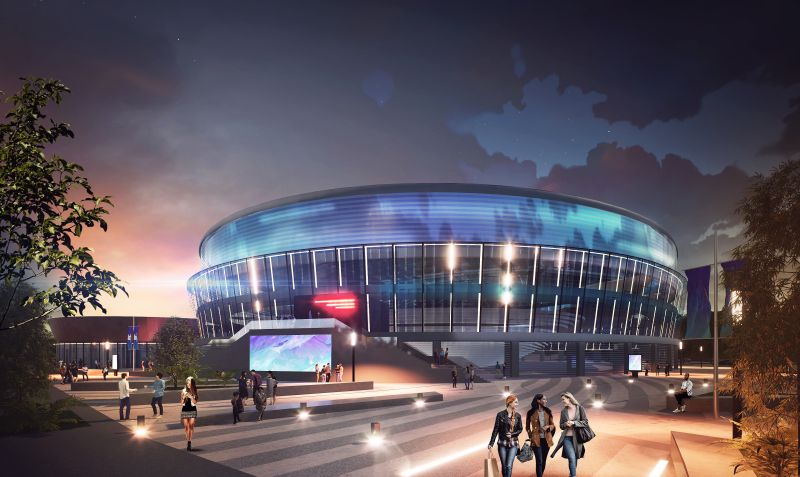
Before long, a consortium had come together with an ambitious goal: to build a €250 million ice hockey arena in Dublin.
From a series of conversations over coffee, Prime Arena Holdings was born.
“We built a really strong team around us — a team we believed could actually make this happen,” Rigley told me last week, after the consortium secured another wave of investors.
If the original backers were largely local figures, the latest additions were anything but.
Rob Blake is a Stanley Cup champion and former general manager of the Los Angeles Kings, a major ice hockey franchise in the US. Pat Flatley is a former captain of the New York Islanders and a Canadian national team player (“He has strong Irish connections,” Rigley says.)
Cory Cross is a two-time International Ice Hockey Federation world champion with Team Canada.
The list goes on.
For Rigney, the willingness of so many prominent figures from the sport to back the fledgling venture is both an endorsement of the idea and a sign that Ireland may be ready to embrace a game long considered outside its sporting culture.
“What we’ve managed to get in is the equivalent of Premier League players and ex-managers from the Premier League. These are household names,” Rigley says, adding that more backers will be unveiled over the coming months.
“There’s been huge interest to try and help make this happen, including potential investors in North America.”
Since those early coffees, Rigney, the former chief commercial officer with Pro14 Rugby, has been busy piecing together the consortium, cutting land deals, and developing a wider business plan for the venture.
Slowly, surely, he argues that it is coming together.
Prime Arena Holdings is set to acquire land from the property firm Hines in Cherrywood in south Dublin, and the development will feature an 8,000-plus capacity arena, expandable to more than 10,500 for big events, and include two Olympic-sized ice rinks.
The plan is to launch a Dublin ice hockey team that will compete in the UK league. However, the arena will also serve as a national hub for winter sports as well as a concert and corporate events venue.
“What we are building is a scaled-down Madison Square Garden,” Rigley, now chief executive of Prime Arena Holding, says. “We’ve always said it’s a North American sports entertainment experience, but it’s really a multifunctional piece of legacy infrastructure. If you think of Madison Square Garden, it’s 365 days, and it has 750 events.”
Sport will be a big piece of the project, and the ice hockey franchise will be a cornerstone. However, Rigley envisages conferences, gala dinners and much more besides. Already, he is exploring the possibility of developing an adjacent hotel.
“You can cover the ice in 45 minutes,” he says.
“You can have basketball games. You can attend conferences, exhibitions, and concerts. So you could have an ice hockey game on a Friday, and it could be opened up to the community on a Saturday. Then you could have a concert on a Sunday. You could have conferences from Monday to Thursday, then it flips over again.”
In addition to private investment, Rigley is also in talks with the State – both at national and local levels – about additional support and funding. As he puts it, no arena in the world is built without a level of State support.
“This is a legacy project that will deliver €298 million every year for decades to come. Even if you look at the North American states, is quite normal for a private consortium to get public funding,” he says. “Look at the GAA, the FAI or Horse Racing Ireland. They would have looked for capital support, and Sport Ireland does a fantastic job there. What we are bringing to Ireland is that public-private partnership, which is done outside of Ireland a lot. It is quite normal.”
The consortium, he says, will put up most of the capital.
“The government are seeing sports diplomacy as a major tool in their arsenal for Ireland Inc and the diaspora,” Rigley argues, pointing to the support in bringing American football and the Ryder Cup to Ireland. “We are the last capital city in Europe without a facility like this.”
Rigley and the rest of his team, based in Dun Laoghaire, are working to a tight timeframe.
The group hopes to get the project approved by the first quarter of 2027 and to commence work in the middle of that year. All going well, the venue could be open by the end of 2029 or the start of 2030.
The venue is being designed by the renowned sports architecture firm Populous, whose portfolio includes the Sphere in Las Vegas, Tottenham Hotspur Stadium in London, Yankee Stadium in New York and Seattle’s Climate Pledge Arena.
“We’ve got a crack team on this. They are on it day and night, and we’re well on schedule,” Rigley says.
In addition to ice hockey and events, the venue will also be available to the Olympic Federation of Ireland to help train elite athletes.
“They now have a facility, for the first time, for their athletes to make sure they don’t have to leave the jurisdiction to train for the Winter Olympics,” he says.
Overall, the way Rigley sees it, this arena will benefit Ireland and the community.
Five years ago, it started with a conversation over coffee in Greystones about whether ice hockey could work in Ireland.
Today, backed by entrepreneurs, broadcasters, investors and some of the biggest names in North American sport, Rigney believes the question has become something much bigger: not whether it can work, but whether Ireland can afford to miss the opportunity.
“You will feel that you’ve stepped into a North American entertainment experience,” Rigley says.
Elsewhere last week…
Alan sat down with Ruadhán Mac Cormaic, the editor of The Irish Times. In his first major interview, the 44-year-old leading the digital transformation at Tara Street talks about the challenges of a job that consumes him, his days as a serious-minded student editor, and more. The piece runs over two parts.
A lengthy investigation by Niall revealed that Ireland approved €20 million in dual-use exports to IDF and the Israeli Defence Ministry at the height of the Gaza war. Internal files show that approvals were granted in 2024, with a later reversal in 2025 citing risks to human rights and regional stability.
A detailed series of court affidavits and WhatsApp messages has revealed a deteriorating relationship between Paddy McKillen Jr and a lender, now at the centre of a contested €2.1 million bankruptcy claim. Francesca has the details.
Two years after it entered the Nasdaq, Alternus, an Irish company promising to become a leading transatlantic solar power producer, is leaving investors and creditors to nurse heavy losses. Thomas had the story.