Voices
Charleston Road is not the sort of place you expect to launch a multinational company from.
It is a residential street in the heart of Dublin 6, a stone’s throw from the Ranelagh triangle. Its inhabitants are typically barristers, accountants or six-figure aviation executives.
Yet, it was here, on this street, that one of the country’s most successful businesses was born. And that business was a world removed from the surroundings – this was not a financial or a legal firm, it was based around mechanical engineering.
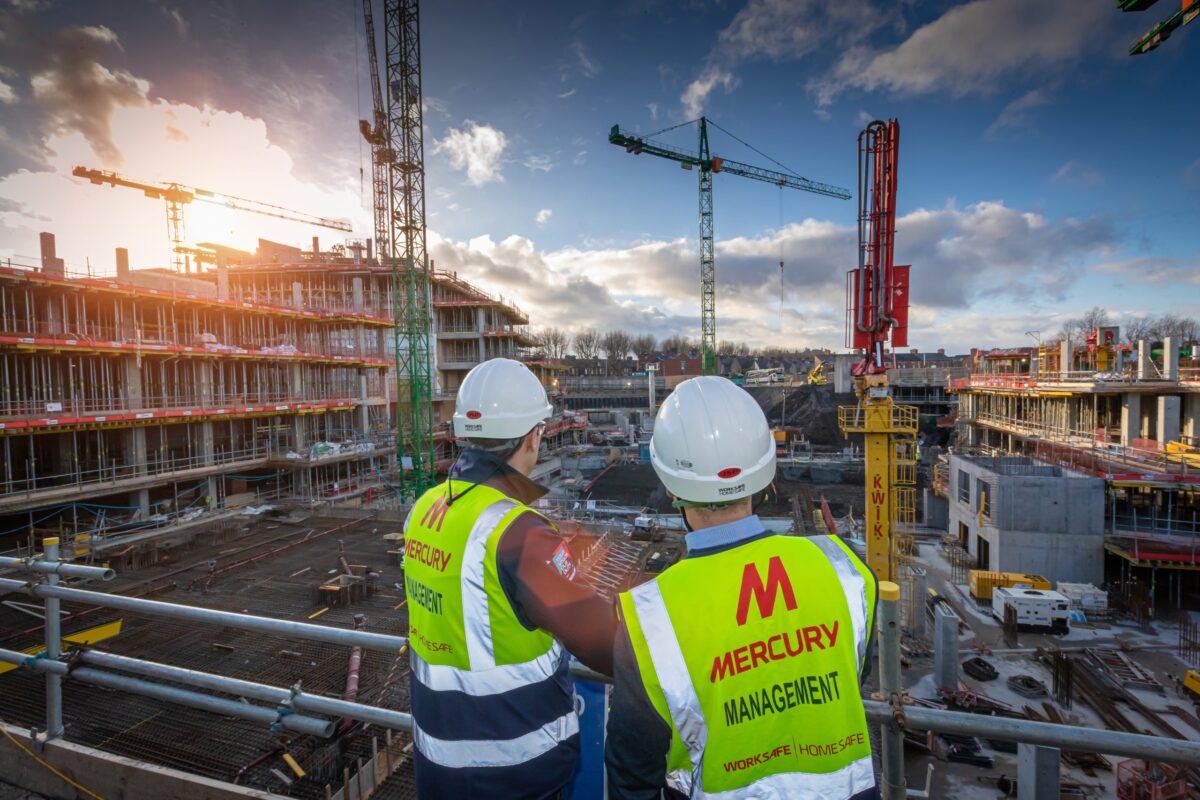
Last week, Mercury Engineering released its financial accounts for 2025. And those numbers were astounding.
Revenues hit €2 billion for the first time, eight per cent more than the previous year. The group’s operating profits rose 13 per cent year-on-year, increasing from €113.5 million in 2024 to €135.7 million last year.
The ambition does not end there.
Mercury aims to increase annual revenues by two-thirds to €3 billion by 2029, according to a plan the company published last year.
Its strategy document, titled Go Beyond, identifies several European regions where Mercury sees significant growth opportunities. Among them are the Nordics, where the company expects turnover to rise to €750 million by 2029, up from €69 million in 2023.
It is an amazing success story and one that began on the streets of Dublin 6.
It was an area that its co-founder, Frank O’Kane, grew up a world removed from.
His father, Edward, was a farmer and cattle dealer, while his mother, Anne Teresa Forker, was a native Irish speaker from the village of Annagry in Co Donegal.
O’Kane grew up in Strabane and attended St Columb’s College in Derry. After leaving school, he joined JJ O’Kane Electrical Engineering, a business owned by his brother.
He moved to Dublin in the mid-1960s to work for Rotary Engineering. Around the same time, he met and married Rosaleen Dooher from Lifford, Co Donegal.
At Rotary, he got to know Joe Morgan, a man who would play a pivotal role in his life.
In 1972, O’Kane and Morgan left Rotary Engineering to establish their own business. The genesis of Mercury Engineering was formed.
At the time, Ireland was hardly an obvious location from which to build an international engineering contractor. The economy was weak, and opportunities were scarce.
But O’Kane and Morgan saw something others did not – and from the start, they looked globally.
During the difficult economic climate of the 1970s and 1980s, Mercury expanded into the Middle East and Africa, taking on projects in markets such as Libya. The experience sharpened the company’s expertise in complex industrial engineering.
That positioning proved pivotal to the company’s long-term success.
Take Intel. When the chipmaker arrived in Ireland in the early 1990s to build its semiconductor facility in Leixlip, it placed demands on contractors that were unlike anything the Irish construction industry had previously encountered. Precision mattered. Technical capability mattered even more.
Mercury delivered.
Its work on Intel’s Fab 14 project became a defining moment for the company, establishing Mercury as a contractor capable of handling highly specialised industrial projects for multinational clients.
From there, the business followed the multinationals.
Mercury has worked on pharmaceutical facilities, semiconductor plants and major infrastructure projects, including the Port Tunnel and the Luas. As the IDA attracted global technology and life sciences companies into Ireland, Mercury successfully embedded itself deeper into the supply chains of some of the world’s largest corporations.
The company continued to expand aggressively even after Frank O’Kane’s sudden death while hill walking in Wicklow in December 2007 – his friend and business partner, Morgan, was with him at the time.
In his obituary in The Irish Times, it stated: “Frank had a wide circle of friends in politics, arts, business and sport. He was a generous host. Social evenings were not just fun – they were a time for Frank to explore ideas and strategies. Many charitable causes benefited from his generosity, given quietly.
“Frank’s contribution to Ireland was acknowledged in 2003 when he was awarded a Doctorate of Laws by UCD.”
Just before Christmas in 2017, management at Mercury Engineering finalised a deal to acquire the company.
While the purchase price was not disclosed, documents later filed with the Companies Registration Office showed that Mercury Enterprises, a newly incorporated Isle of Man-based company, invested €147.4 million in cash in Mercury Holdings, the group’s parent company.
The management buyout was led by chief executive Eoin Vaughan alongside chief operating officer Rickie Rogers and finance director Ronan Lynch. The O’Kane and Morgan families retained minority shareholdings.
At the time, the valuation looked substantial for an Irish engineering contractor.
Today, it looks extraordinarily modest.
As technology companies raced to build data centres across Europe, Mercury emerged as one of the principal beneficiaries.
The company’s revenues have almost quadrupled since the deal was completed.
Under Vaughan’s leadership, Mercury has expanded aggressively across mainland Europe, opening new operations in Germany, the Nordics and southern Europe.
What distinguishes Mercury is that it rarely behaves like a traditional construction company.
Its expertise lies not in pouring concrete or erecting steel frames, but in delivering the highly specialised mechanical and electrical systems that sit at the heart of data centres, semiconductor facilities and pharmaceutical plants. Those projects demand precision, technical expertise and execution capabilities that relatively few European contractors possess.
That specialisation has insulated Mercury from many of the cyclical pressures that typically define the construction sector and helped deliver profit margins well above many industry peers.
Yet despite the scale of the business, Mercury remains relatively unknown outside engineering and corporate circles.
Still, there is something striking about the trajectory.
Not bad for a business that began on a quiet suburban street in Dublin 6.
Elsewhere last week…
In 2020, the French-owned Emera Group bought a majority stake in nursing home operator Virtue. Now the founders of the €150 million business claim they are being oppressed by the private equity-backed investor. Francesca had the story.
Decades of neglect have left many regional courts in disrepair, impacting access to justice and sparking fears of “legal deserts”. As practitioners campaign to save them, the Courts Service is trying to balance preservation with consolidation of its estate. Niall examined the issues.
Aine Denn, the entrepreneur behind one of Ireland’s biggest SaaS success stories, reflected on scaling Altify, the realities of an $84 million sale, and why she believes AI has created the perfect moment to launch again.