Voices

Ask anyone with a moderate knowledge of the Irish food-and-drink industry how they think it is doing on the innovation front, and they are likely to say “pretty well”. Ireland has a history of punching above its weight on global food markets, punctuated with success stories stretching as far back as the launch of Kerrygold butter in 1962.
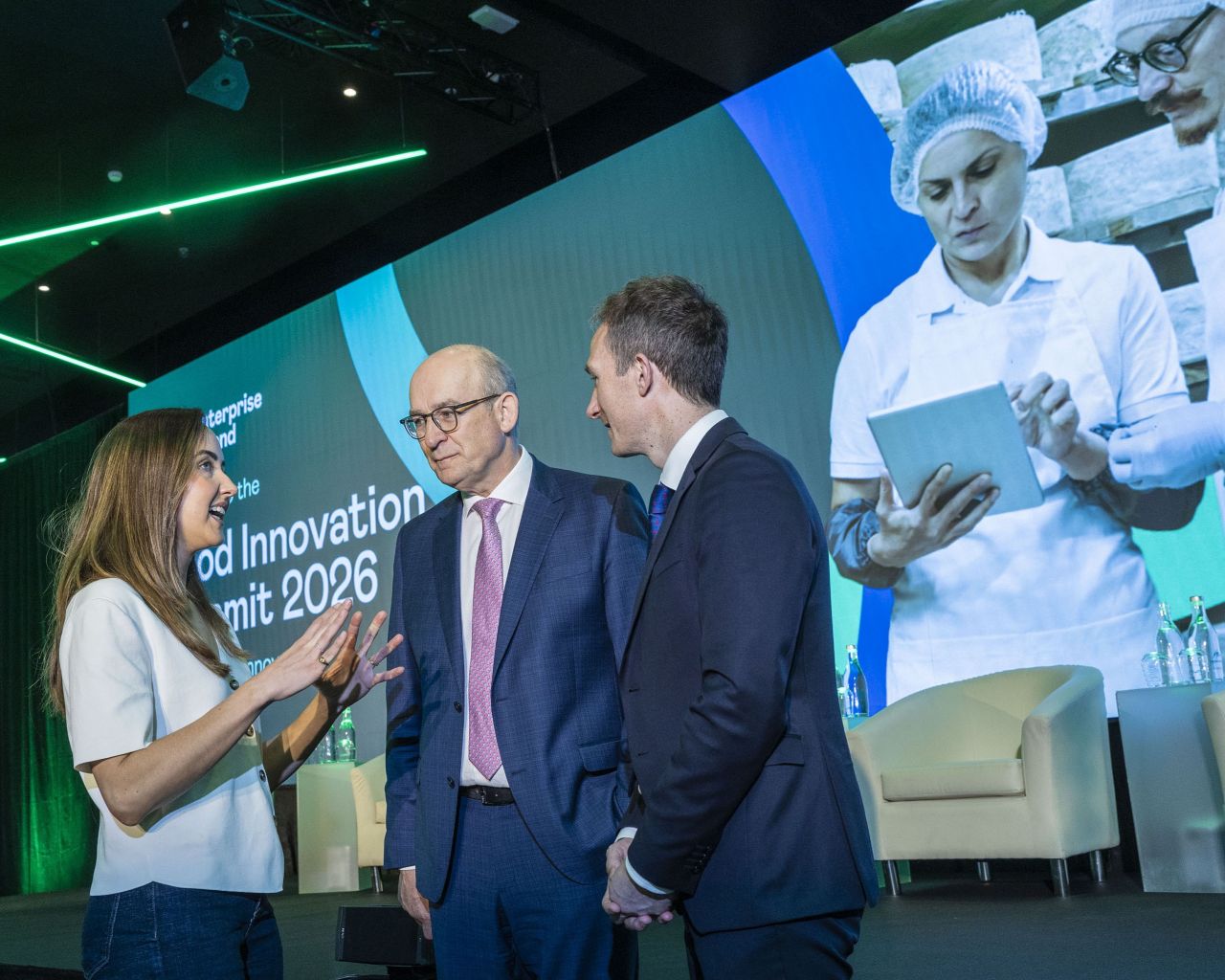
After spending most of Tuesday at Enterprise Ireland’s food innovation summit, however, I began to get a sense that a two-tier industry has emerged. A proportion of businesses are at risk of resting on the laurels of ever-growing export figures trumpeted annually by Bord Bia.
I blame Kerry Group.
Many observers tend to see the wood of the undisputed Tralee-headquartered food technology powerhouse, along with nutrition multinational Glanbia and the ruthlessly efficient meat factories of Ireland’s beef barons, for the trees of an SME-dominated industry with far less appetite for innovation. I plead guilty.
When I interviewed Kerry Group’s chief executive Edmond Scanlon last year, he mentioned KerryKalaido. This proprietary AI tool is capable of assembling any product concept from the ocean of patented ingredients, recipes, consumer insights, and market data in Kerry’s possession.
Marketing executive Orla Stafford demonstrated KerryKalaido to me at Tuesday’s event. In a few clicks, she prompted it to suggest a new alcoholic beverage in a shot bottle that would appeal to Gen Z consumers this summer in Britain and Ireland. “Peach elderflower summer spirit,” came the answer – a vodka drink complete with a recipe, ingredients list, marketing tagline and label design.
This is just the beginning. Kerry Group’s global supply chain director Brian O’Connor said the company had deployed a new AI agent that constantly scans its supply chain for risks. When stocks of a product are low in one place and high in another, the agent detects the gap, analyses the cost-benefit of moving some stock, and presents managers with scenarios.
Rather than using AI to improve existing processes, O’Connor said it offered an opportunity to “re-engineer what we do”. Increasingly, he added, his colleagues were interacting with AI as a co-worker rather than a piece of technology, and managers would regard their team as formed of a combination of people and agents.
Scary? Maybe. But with half a million consumer orders to process every year, you can understand why Kerry wants to automate a portion of its workload. Another customer-facing AI tool, KerryNow, does just that.
Scarier, however, is the distance between this level of innovation and the rest of the industry.
Tuesday’s official speeches included the customary praise for a food industry that is the key employer in many towns and has weathered countless crises. But they also contained a warning.
Minister for Agriculture Martin Heydon outlined tens of millions of euro invested by the Government in new food innovation and research centres as well as biorefineries, which offer new ways of adding value to waste streams.
This approach was illustrated by the west Cork group of dairy co-ops Carbery, whose director of sustainability Enda Buckley detailed the steps added to extract products from the by-products of butter and cheese. Its whey is now separated into high-value protein isolates and permeate, from which the lactose is further processed with enzymes and distilled into bioethanol. The final waste from this process goes into the factory’s anaerobic digester to produce biogas.
Heydon also mentioned a pilot to harness Irish crops in the production of fibre ingredients – a new global market alongside protein, driven by demand from users of GLP-1 weight-loss drugs – not to mention the various grants available to companies.
But “is the sector making sufficient use of this?” Heydon asked, rhetorically. “Ultimately, innovation requires businesses to make the investment.” And this spending, currently at 0.7 per cent of sector revenue, has fallen short of a national target of one per cent, he pointed out.
Enterprise Ireland chair Jim Woulfe, a veteran of the Irish dairy co-op sector, also referred to the missed one per cent milestone in innovation investment. “Such deferring is like eating your seed potatoes,” he warned. This hasn’t led to famine yet, but the image was stark.
The frontier of food
There are plenty of entrepreneurs operating at the frontier of food, and several were on hand on Tuesday to share their experience.
Some were start-up founders pitching for investment. They may appear on the radar of Tirlán after the Kilkenny-headquartered farmers’ co-op freed up €257.6 million in cash from its Glanbia shareholding earlier this month to diversify its investments, including through venture capital.
Ian O’Rourke of RYSE said his company’s caffeine-fueled energy chocolate bars had reached 400 Irish stores since The Currency covered its launch one year ago. Its product is now entering the US and O’Rourke is talking to investors to fund its next phase of growth, when RYSE will look at adding other functional ingredients to chocolate.
Lisa Hughes, co-founder of the Gigi brand of supplements for women at times of hormonal change, explained how her company had raised a €1.5 million seed round earlier this year, promising to secure scientific proof for the benefits of its products. After their launch in the UK in April, they’re due to undergo clinical trials next year.
This evidence-based approach follows that of Marigot Ltd, a Cork-based manufacturer of seaweed-derived minerals and protein ingredients. Its R&D director, Denise O’Gorman, said the company did not have a large lab itself but was collaborating with universities – especially Irish ones, which have good access to grant funding. Such collaborations have led to 64 peer-reviewed publications in scientific journals, O’Gorman said.
Between the cutting edge achieved by large groups and the younger companies established purely on the back of R&D, however, there is a vast SME sector largely untouched by the advances of AI or the discovery of new ingredients and processes. Yet several examples show that entering the innovation arena can be less daunting than it seems. The same could be said for other industries in the domestic economy.
Stephen Browne recently acquired IO Resource, a distributor of point-of-sales terminals and scanning and tracking equipment to retail, hospitality, pharma, and farm businesses. Over just three months of overlap with the business’s previous owners of 30 years, he conducted a marathon of recorded meetings stored in the company’s SharePoint cloud to retain his knowledge.
“After we re-created the founder’s brain, we wanted to do it with the company’s brain,” Browne said on Tuesday. Despite its small size, IO Resource has introduced an advanced policy whereby its 10 staff share their work documents and record their meetings in SharePoint. This “one single source of the truth” in the company is then exploited by the AI agent Claude Cowork, which automatically circulates reports and agendas.
Although staff were sometimes worried that AI could replace them, Browne said: “The reality is that it is removing mundane parts of the job and allowing more time to talk to customers and do what AI cannot do, which is human relations.”
“We don’t laugh any ideas out of the room.”
John McCallum
John McCallum, chief executive of Mannings Bakery, shared his experience of another side of innovation: the cost of new product development. His bakery’s quest for new treats, such as Portuguese-style sourdough and alcohol-infused cakes, came from within the company. “We don’t laugh any ideas out of the room,” he said – any co-worker’s suggestions go through the same examination.
But when it comes to experimenting with new recipes, costs can rack up. One way Mannings has kept them in check has been by renting equipment. When an attempt at liquid sourdough production didn’t work out, the company could give back the associated machinery after two months, McCallum said.
“If you’re going to fail, fail fast,” he added. In another example, Mannings realised that there was no demand for marshmallow brown bread and quickly moved on to the next idea after cutting small losses.
Serendipitously, the panel he joined was moderated by Lyndsey Browne, an EY tax partner who handles R&D tax credit claims for companies. Much of the costs McCallum described, from rented equipment to discarded test products, appeared to be eligible to the tax break – and he could still claim for 12 months after incurring them, she informed him: “Let’s talk afterwards!”
The R&D tax credit, which increased from 30 per cent to 35 per cent of eligible expenses this year, is notoriously captured by foreign multinationals (they accounted for almost €6 billion of Ireland’s €7 billion spend on R&D in 2023, according to the CSO). While this tax break’s requirements are complex, most domestic companies, such as those in the food industry, have probably never looked at it.
Yet innovation can erupt in the most traditional of businesses – if they put their mind to it and hire the right people. Nicholas Dunne, the ninth-generation Wexford dairy farmer whose family has turned the Killowen Farm yoghurt brand into a household name, explained how his family had recently launched protein yoghurt and overnight oats, identified by its new product developer.
Her name is Fionnuala Crimmons. She cut her teeth as a food innovation technologist at Kerry Group.
Elsewhere last week…
The Co Sligo property developer Cathal O’Connor has weeks to put his business affairs in order before starting a custodial sentence for the violent assault of three teens. Niall examined the scale of his property network, multi-million euro assets, and projects in the pipeline.
As a journalist, colleague and long-time observer, John Collins saw how Eoghan McCabe and his co-founders built Intercom into one of Ireland’s most influential technology companies. He reflected on the recent $3.6 billion sale of the business, now known as Fin, to Salesforce.
Mail Metrics is one of Ireland’s fastest-growing businesses, employing over 600 people with revenues in excess of €200 million. Its CEO Nick Keegan told Michael how it turned from a summertime project into an international business.