Voices

Jerry O’Callaghan was born in 1953 and grew up on a 30-acre farm near the sea in southwest Cork.
“It was very basic in the 1950s,” he told me when we spoke last week. “We had no electricity. We had no running water. We had no toilet, indoor or outdoor, and we were six kids. We were barefoot in the summer and in Wellingtons in the winter. It was that kind of atmosphere.”
His oldest brother inherited his uncle’s farm, while his second-oldest brother got the family farm. As the third son, this left nothing for him.
As a boy, O’Callaghan trained as a novice Presentation Brother and went to boarding school as a result. “I left home at 12 going on 13,” he said. “I was a regular boarder in Cork, and then I went into the monastery for another three years.”
After O’Callaghan turned 18, he started to rebel.
“I kind of stuttered, and when I stuttered, they kicked me out in the sense that I was unsure of where I was going,” he said. “So as not to contaminate the other prospective brothers, I had to leave in a rush, and I did.”
O’Callaghan went instead to UCC to study engineering on a scholarship, where, after his years in the monastery, he enjoyed himself too much. “I let my hair down and got myself into a bit of a mess. I burned through my scholarship in the first six months, so I had to go and work part-time as a barman just to survive,” he said.
When he finished university, O’Callaghan moved to London. “I worked a little bit, got some money together, and then I went overland to India,” he said. “I was planning to get some religious enlightenment in India, and I ended up spending about a year in the south of India living on a beach.”
O’Callaghan was 22, soon to turn 23, and feeling restless. He returned to London. There, he met a Brazilian woman who invited him to visit her country – a chance encounter that would prove life-changing.
“In March 1979, I went to Brazil to meet this girl’s family and all of that. I went to Brazil, and I fell in love with her and with Brazil, so we got married, and I got a job,” he said.
There, he entered the industry that would define his career.
“I got into the meat industry in 1983, and I’ve been in the meat industry ever since,” he said.
He joined JBS in 1995 to develop the export market, the international aspect of the business. “It was a Brazilian-centric company, and so I helped open up the floodgates.”
JBS Global is a Brazilian multinational that ranks as the world’s largest meat processor. Employing 280,000 people around the world, the business, across its various arms and brands, had sales of $96 billion last year.
It is also among the country’s most controversial, having been mired in a string of corruption charges and with its founders sentenced to jail.
The company also has substantial investments in Ireland, including Moy Park, an 80-year-old poultry producer employing around 10,000 people, and a major food, meat and prepared meals business that Pilgrim’s Pride, its subsidiary, acquired from Kerry Group.
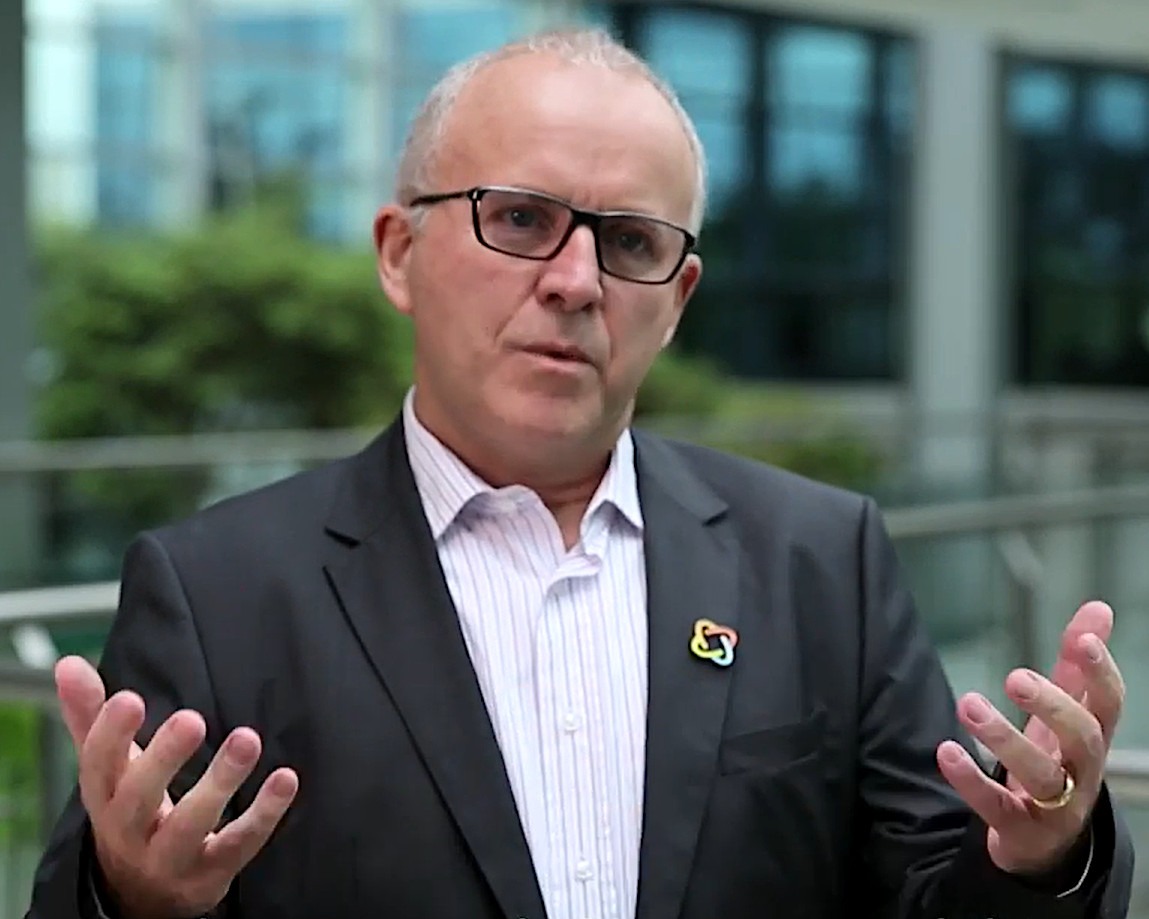
O’Callaghan has long been one of JBS’s top executives — he led its investor relations operations as it prepared to float. Today, at the age of 74, he is its chair.
I caught up with him when he was in UCC to attend the International Food and Agribusiness Management Association’s annual conference.
After watching students present their agribusiness projects, he took to the stage to share his thoughts on the future of protein.
I asked if JBS would make more acquisitions in Ireland and if it would ever buy a beef processor. “This thing about doing more – if you go out to do more normally, it’s not the way we do it,” O’Callaghan said.
“It’s like we always say that acquisitions and expansion are something that needs to come to us rather than for us to go to them.
“If we felt there was something that was synergistic with the businesses we have anywhere in Europe, including in Ireland, we would look at it. But it would have to come to us. That’s kind of how we’ve made basically all our acquisitions.
“We have a balance sheet that’s healthy, that would support an acquisition, be it big or small. Be ready always. Obviously, there are companies we look at that we would love to engage with, but I’m not going to tell you the names.”
Moy Park, he said, was an exciting business.
“It’s performing really well. It is profitable, but not brilliantly, but good enough to be satisfied with it. And then we felt we should grow again, sort of go upstream a little bit to more branded products.”
What does O’Callaghan think of the Mercosur agreement, which has been opposed by the Irish beef industry? “I think we should talk about trade agreements more broadly,” he said.
“From a very much global perspective, and because of conflicts and food security-related issues, we’ve seen a lot of what I call de-globalisation over the last number of years, and we don’t think that that is necessarily in the best interest of customers and consumers.
“Obviously, we favour trade agreements, because almost one third of all our revenue comes from products that are consumed in markets outside of where they are produced,” O’Callaghan said. Markets like Brazil could be potentially very big for strong Irish food and drinks brands like Irish whiskey, Guinness, Kerrygold, cheese, and so on.
“There are 260 million people in that South American block with a growing middle-class population,” he said, adding that 80,000 Brazilians lived in Ireland, and they could act as ambassadors for Ireland when they returned home.
“There are so many opportunities. There are so many people that aspire to have a better diet around the world,” said. “You kind of get on with your business, and you look for doors that are open, and you don’t keep banging on doors that want to close on you.”
O’Callaghan said he was inspired by listening to the students he met in UCC, and it prompted him to think about his time there. He said his advice to the students was to “think beyond Ireland”.
“It costs about €1,000 to fly to South America or to Africa or even to South East Asia, so go out, see what’s happening abroad, see the opportunities,” he said. “All of the skill sets we have in Ireland around farming and livestock management and land management can be applicable in many parts of the world where land is much cheaper than it is in Ireland.
“Why not think about broadening your investment horizon beyond Ireland? You can buy land in Paraguay today for less than €1,000 euros a hectare, good land. So, I would say to people, broaden your horizons and look at the commercial opportunities that exist out of Ireland. Try to break away from the negative narrative and think about the opportunities.”
Elsewhere last week…
Dermot Desmond’s action against The Irish Times was settled before trial this week, bringing to a close a 10-year legal battle that raises fresh questions about the length of time it takes for a defamation action to reach trial. Ian examined the case that outlived the consequences.
The promise of eConveyancing first appeared in a Government bill 20 years ago. The jury is out on efforts involving estate agents, solicitors, banks, and many others to shorten often archaic home transfers. In a major report, Thomas investigated the issue.
Architect Róisín Heneghan told Hannah the story of how her Dublin-based firm won the commission for the Grand Egyptian Museum and why the landmark project took more than two decades to complete. It is a fascinating look at ambition, architecture, politics and perseverance.
Eight months into his role at the helm of Research Ireland, Diarmuid O’Brien spoke to Michael about why he left the University of Cambridge, the role research will play in driving Ireland’s economy, and why Ireland should have its own Station F.