Voices
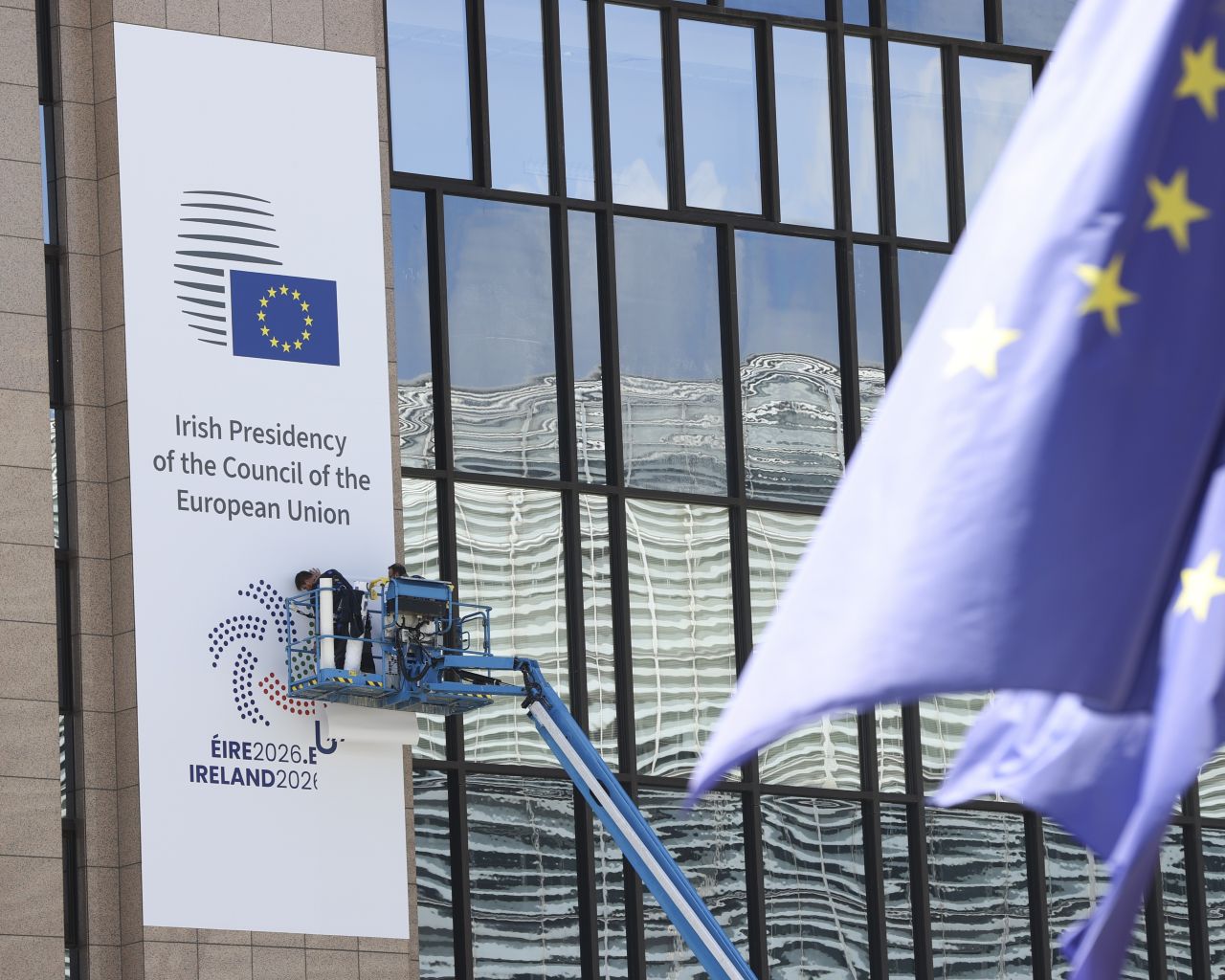
This is it, Ireland is in the hot seat. There has been no shortage of commentary on what Ireland should do as president of the Council of the EU, amounting to a lot more than any country can achieve in the six-month rotating role.
But what can the Irish presidency realistically achieve?
To narrow this down, it is worth remembering that the Council, representing the national governments of all 27 member states, is one – admittedly the most powerful – of three co-legislators. If the EU was Ireland, Ireland is now Ceann Comhairle of the Dáil. The EU’s Taoiseach-like executive chief, European Commission President Ursula von der Leyen, remains firmly in Brussels (via Dublin and Cork last week).
Legislators’ number one power everywhere is to decide the budget. Ireland has form, having steered member states into agreeing the EU’s 2014-2020 multi-annual financial framework 13 years ago. There is genuine appetite on the part of Minister of State for European Affairs Thomas Byrne to secure a deal by November.
This is a tall order, with no consensus on how to close gaps in the €2 trillion seven-year budget plan, how much the EU should borrow, and how far new priorities around security and defence should eat into traditional ones like the Common Agricultural Policy. But this is what Irish diplomats and politicians are good at – patient negotiation around solutions that become gradually acceptable to more and more participants. Brexit comes to mind.
This one is doable, with help from the deadline of a terrifyingly uncertain French election next spring. The 2013 talks ended with every country paying a bit more into the EU budget, and getting a bit less than they hoped. A repeat is likely. Closing off budget negotiations would build enormous goodwill for Ireland for years to come around Europe.
An easier win for Ireland might be the passing of the grids package, a suite of reforms for electricity and gas networks. It is now entering the trilogue phase when the Council and European Parliament try to hammer out a deal based on their amendments of initial proposals from the Commission.
This is a technical area, aimed at modernising the rules governing energy transport across the EU and harmonising them according to the best practices observed around Europe.
Ireland has skin in the game. Its electricity grid is both swamped by demand from data centres and the challenge of plugging in future offshore wind farms, and seen as an international model for its innovative accommodation of high proportions of renewable energy.
The energy industry complains that many Irish rules remain antiquated, however, hampering the connection of more efficient technologies, and grid reform here is too slow. Passing these kinds of hot potatoes to the EU level is a well-worn Irish way of dealing with such problems. This is a promising example.
The competitiveness agenda, trumpeted by the Government as a presidency priority, can show progress in two areas. One is EU Inc, the so-called 28th regime, intended to allow small companies to complete a single registration allowing them to do business across the bloc. Many details remain to be decided – tax being a big one – but with Irish Commissioner Michael McGrath pushing the project, close alignment between Dublin and Brussels will help significantly.
One thing companies cannot yet do on an EU-wide basis is raise funds, and the Savings and Investments Union aims to remedy this. Taoiseach Micheál Martin has repeatedly expressed commitment to this and signalled a lifting of Ireland’s veto against more centralisation of funds supervision in the Paris-based European Securities and Markets Authority (Esma). Another win is in sight here.
Can’t dos
There is little chance of progress on more controversial aspects of competitiveness, such as digital regulation. Much like energy grid regulation, Ireland would love the EU to take the lead on thorny issues like the restriction of children’s access to social media.
Other member states, however, do not trust Ireland to lead such discussions as they rightly consider Dublin is under the influence of tech lobbyists. There is, in any case, no consensus within the Irish Government in this area between pro-regulation Fianna Fáil and pro-multinationals Fine Gael.
Minister for Foreign Affairs Helen McEntee confirmed this in a LinkedIn post last month after meeting Meta’s chief lobbyist in Ireland, Dualta Ó Broin.
The meeting took place amid layoffs at Meta’s Dublin office and contractors (including among content moderators) and clamour for measures to protect children from its Facebook and Instagram algorithms, three days after Facebook whistleblower Sarah Wynn-Williams sat in silence during a discussion about her book at the Hay Festival in Wales in application of a gag order secured by Meta.
Yet McEntee posted a message that could have been written by the Silicon Valley firm’s own AI chatbot.
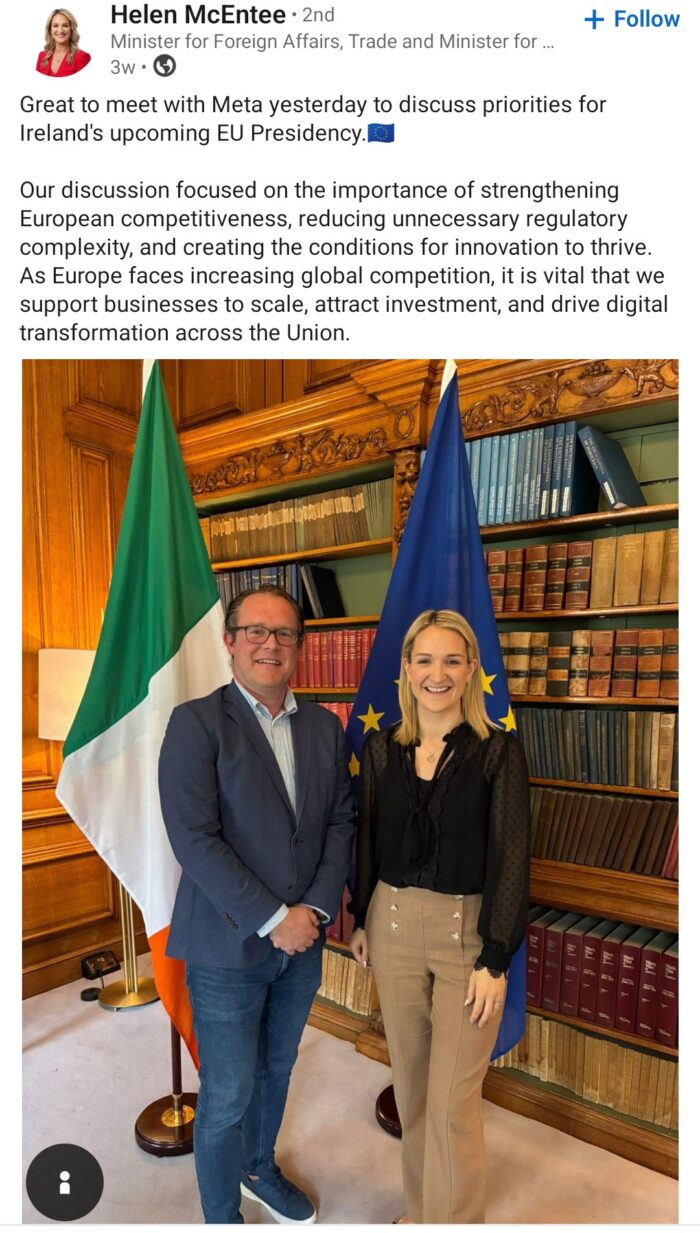
Ó Broin was so comfortable in the corridors of Irish power that he posed for a photograph with the minister wearing jeans and runners. While McEntee’s brief does not cover digital regulation, she leads the diplomatic service that will deliver Ireland’s message during the EU presidency. When it comes to digital giants like Meta, it will be one of “reducing unnecessary regulatory complexity”.
There is similarly little progress to be expected under Ireland’s presidency towards climate measures, such as the EU’s proposed reform of the Emissions Trading Scheme (ETS) covering large polluters. Aviation is too big an interest here for the Government to act as an honest broker in this area.
This leaves big geopolitical and diplomatic crises, where the Irish presidency intends to focus on “values”. Irish support will help Montenegro’s efforts to join the EU, with negotiations set to end this year, and accelerate Ukraine and Moldova’s path towards membership.
But getting a seat for Europe at the table of elusive Ukrainian peace talks will likely prove impossible as the EU is rife with infighting on the diplomatic channels and strategy to use when facing Russia. Ireland’s own Aughinish Alumina time bomb will not help its position.
Don’t expect any tangible effects from Ireland’s stance on Israel and Palestine either, as EU action remains blocked by larger member states and the Commission.
Elsewhere last week…
The London-based private-equity firm August Equity took a majority stake in Alkimii, an Irish hospitality software business founded by former Jurys group IT chief Ronan McAuley. Its product is already used by high-profile clients like The Killarney Park hotel, and August partner Katie Ballardie told Michael that Alkimii can grow in the wider hospitality sector and overseas.
While the IDA reported growth in FDI investment in the first half of this year on Wednesday, efforts to attract semiconductor manufacturers here and elsewhere in Europe are “struggling”, according to Minster for Enterprise Peter Burke. Jonathan asked about plans to make “mega-sites” available to the world’s biggest chipmakers.
Also on Wednesday, the duo of musicians performing as Bob Vylan sued the BBC in Ireland and Francesca broke the story. The band members have already filed defamation proceedings against RTÉ over its reporting of Bob Vylan’s appearance at Glastonbury festival last summer, when the band led chants of “death to the IDF” over the war in Gaza.