Voices
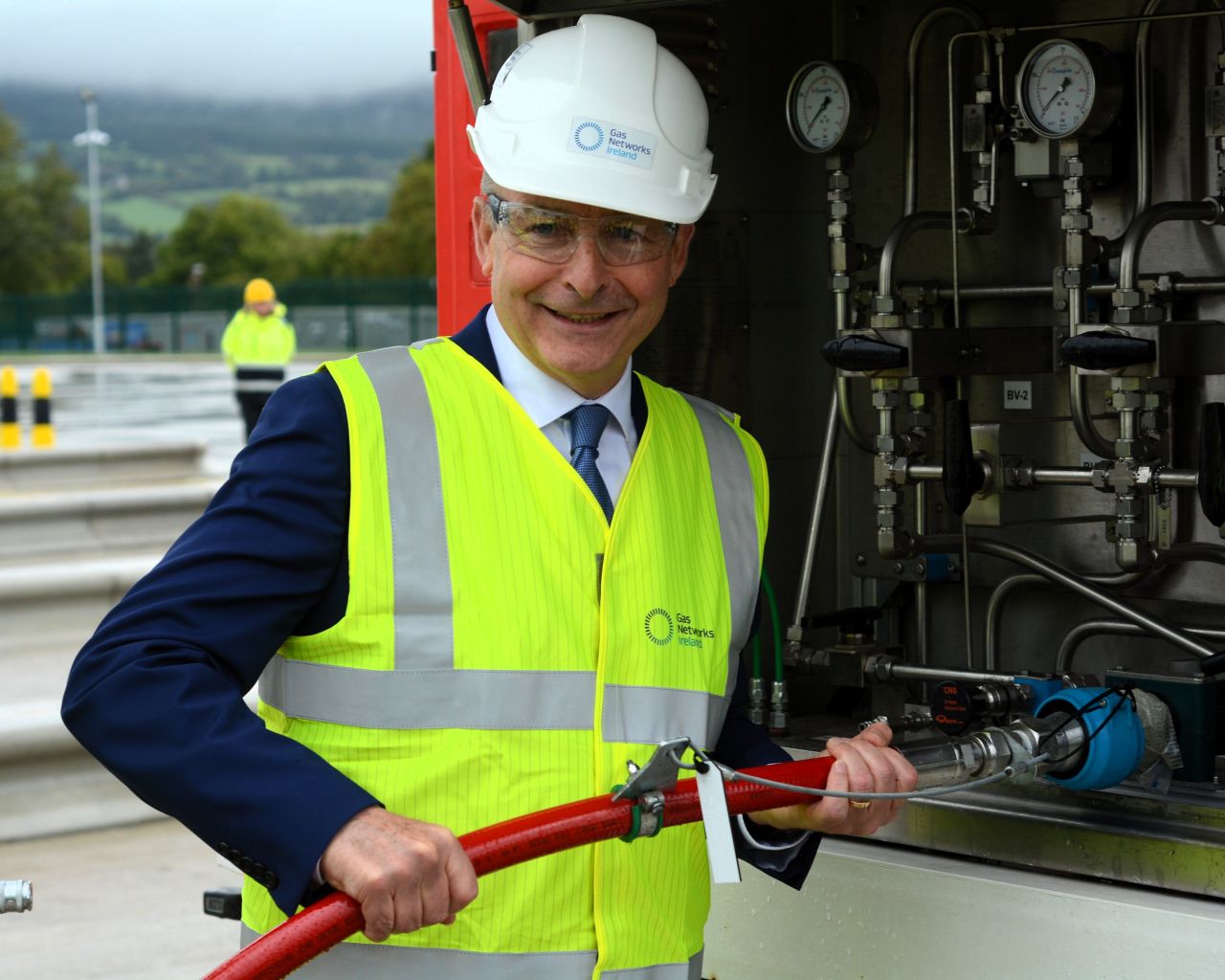
On Friday, as budget negotiations between his ministers reportedly reached a “brutal” stage – a qualification he rejected, recalling his time in the trenches of actual budget cuts after the financial crisis – Taoiseach Micheál Martin found two hours in his busy schedule to open Gas Networks Ireland (GNI)’s new central grid injection point for renewable gas.
The €32 million terminal will allow lorries to dock and deliver biomethane gas collected from off-grid producers, largely farm-based anaerobic digestion businesses planned across the Munster intensive agriculture catchment.
While important for the local economy, this investment will make a modest contribution to weaning Ireland off fossil fuels. If used at full capacity, it would provide less than 2% of the gas currently carried by GNI’s network, according to the semi-state’s figures.
This is the second time the project in Mitchelstown, Co Cork, sees Martin visit as Taoiseach: first to turn the sod two years ago; and now to launch the completed piece of infrastructure. “Very often, you don’t get that through political cycles,” he remarked, to great hilarity among an energy-industry audience used to going through several governments before any promised plank of policy materialises into change for their businesses.
The two dates bookend a period of flux in international energy markets and Ireland’s policy response. In 2024, Martin broke ground in Mitchelstown as the leader of a coalition including the Green Party, which had made decarbonising the economy a matter of principle and a legal obligation.
Interest dropped palpably after independent TDs replaced the Greens as the coalition’s junior partner following the November 2024 election (remember Minister Michael “People Want Tar” Healy-Rae?). But US President Donald Trump, through his adventurist war in the Middle East, can be thanked for renewed focus on alternatives to fossil fuels. This is evident both among the general public, after another record month of electric-car registrations in September, as well as in government.
“We are on a journey of transformation, one where I believe we can ultimately free ourselves from our dependence on fossil fuels, and it is imperative that we succeed for so many reasons, not least those related to energy security, cost, and climate stability,” Martin said – in this order.
The added difficulty is that the Government must now catch up on measures like gradually replacing imported gas with indigenous biomethane, while also finding itself under pressure to subsidise fossil fuels for those who have yet to manage their transition to renewables.
Multinationals pay the bill
Thankfully, multinationals remain committed to paying the bill, as shown in the €4.9 billion in corporation tax receipts collected in September – a month when the take is usually around €2 billion. The figure was published as Martin was speaking in Mitchelstown on Friday.
Department of Finance officials are adamant that this is due to a small number of multinationals choosing to pay corporation tax earlier than their due dates in November and December.
The Department’s pre-budget white paper actually reduced the full-year corporation tax forecast for 2026 by €1 billion to €34 billion, a handy warning for Minister for Public Expenditure Jack Chambers to wave in front of hungry colleagues and public-sector unions.
There is no reason to doubt this explanation – other than prior experience, when so-called “timing differences” turned into permanent rises in the corporation tax take and pre-budget estimates turned out to be overly conservative. It is also unclear why multinationals with armies of treasury accountants tasked with extracting every last return from cash reserves would choose to pay their Irish tax bills up to three months early.
While the link between multinationals and the budget is well documented on the Exchequer revenue side – “We are over-reliant on corporate taxes and on windfall corporate taxes,” Martin said again on Friday – it also struck me on the expenditure side, especially in the crucial energy sector, while touring the gas facility with the Taoiseach.
There, industry leaders were clear that infrastructure was just one part of the puzzle to get an Irish biomethane industry off the ground. GNI connected two other producers directly to its grid in August (Bia Energy in north Dublin and College Proteins in Co Meath, both of which have complementary sources of revenue through gate fees for waste collections). It is planning for four or five more in the coming year. Yet GNI’s chief executive David Kelly told Martin that the French network had 800 and was connecting new ones at a rate of two a week.
For all the infrastructure Ireland builds, it still doesn’t have a viable market for biomethane plants to emerge on the scale required to make a difference. Kelly relayed the clamour in the room for a renewable heat obligation (RHO) scheme comparable to that already mandating the blending of biofuels into petrol and diesel.
“We need to ensure that the market signals are there for further investment. The most imminent signal is the delivery of the renewable heat obligation. Industry needs to see this legislation passed by cabinet, with a clear timeline for implementation, and this will support investment to flow and projects to progress,” Kelly said. Martin replied he had “heard” him.
A €300m electricity subsidy for chip makers
I later asked Martin about the contrast between the RHO, agreed in principle by the Government in 2023 but yet to be formalised (it is now hoped to come before the Oireachtas during its current session), and the details of energy incentives for Intel I reported on last Tuesday.
Within three days in July, the chip maker announced a €5 billion investment at its Leixlip factory in Martin’s presence, and Ireland secured EU state-aid approval for a new €300 million electricity subsidy for large semiconductor manufacturers.
When it comes to the energy challenge, are multinationals ahead of domestic industry in getting support from the Government, like we’ve seen in the past with other incentives?
Martin replied that this was the wrong perspective. “Intel is hugely important to indigenous Irish industry,” he said. “If you ever went up to the Intel site during the last construction phase, nearly every significant construction company in Ireland was there.”
Applying different energy tariffs to large users “makes sense if you think about it,” he added – separately from what smaller businesses are paying. “It’s a false comparison because by definition, in any industry, anybody using higher volumes of energy, there’ll be different rates for them.”
Martin said he hoped for more investment by Intel in the future. “We’re all integrated, and supply chains are complex. But I’ve witnessed, over the years, Irish companies growing, becoming international on the back of their relationships with multinational companies in pharmaceutical, medical devices, technology companies, even data centres. Like, there’s a huge cohort of Irish companies involved in data centres internationally now. They’re exporting companies, and they’re doing it all over the world.
“But we do need to look at further ways to bring people into newer forms of energy, as you’ve suggested, and we, the Government, will be looking at that.”
Elsewhere last week…
Tom met Maurice Regan for an in-depth, two-part interview in the drawing room of his Irish home, the Newtown Anner Stud Farm in Co Tipperary. Part one focused on the epic fight that saw Regan wrest the historic Barne Estate from John Magnier last year and explored the massive growth in his US contracting business, the New York-based JT Magen. In part two, Regan told Tom about his €200 million deal with Gerry Gannon, Irish horseracing, an extraordinary friendship, and what comes next for Barne.
New files seen by Niall reveal that plans to hire new clinical experts to ensure the bulk of cervical cancer screening takes place in Ireland are now delayed. Eight years after the Scally report into the CervicalCheck controversy, this leaves the State heavily reliant on a US commercial lab despite a major €20 million investment in a new Irish facility.
The 2023 Dublin riots were the unlikely catalyst for former energy commissioner Aoife MacEvilly to make her move into media. In her first interview since joining the radio arm of Coimisiún na Meán, she set out her stall for change in an interview with Alan on Monday.
On his recent trip to the European Parliament, Jonathan picked up rumblings against EU Inc, the new legal framework championed by Commissioner Michael McGrath to help companies scale across the EU. He analysed MEPs’ reservations about what it will mean for worker representation.